Painting from a reference photo is something most of us do, at least some of the time. Photographs are incredibly useful. They capture fleeting light, a particular gesture, a pattern of cast shadows, a place we may never return to.
But have you ever noticed how quickly that useful reference photo can start…well…bossing you around?
I see it all the time with artists I teach. Someone tells me they want to loosen up, be more expressive, simplify, use colour more freely, make the painting feel more like theirs.
And then they put the photograph beside the easel.
Suddenly the tree is green, so they use that green. That object is there, so they put it in. The path bends there, so that’s exactly where theirs goes. The camera recorded twelve fence posts, so apparently the painting needs twelve fence posts!
Sometimes I’ll ask, ‘Why did you put that in?’
The answer?

‘Because it’s in the photo.’
Ahhhhh.
When did our reference photograph stop being a reference and start telling us what to do?
The funny thing is, most of us KNOW we can change it. We know we’re allowed to move a tree, leave out a building, change a colour, simplify a shape, exaggerate something.
So why can it be so darn difficult to actually do it?
A photograph looks like the Truth
I think this is part of the problem.
A photograph has a strange kind of authority. There it is, right in front of us. Evidence! The tree was there. The road did bend that way. The building was that colour.
And because the photograph appears to show us ‘what was really there,’ changing it can somehow feel…wrong. Even though we’re making a painting. Sometimes, we may forget that we’re not actually submitting evidence to a court!
Of course, occasionally, we may deliberately want to stay very close to our reference. Perhaps capturing a likeness is important. Perhaps there’s something very specific about the arrangement of shapes or colours that we love. Or maybe we are painting an iconic view. There’s absolutely nothing wrong with that.
The question is whether we’re choosing to follow the reference or simply obeying it.
Those are two very different things.
The photo gives us answers
Here’s another reason I think we become so obedient to photographs: choosing is hard. Right?!
Think about how many decisions you’re already making while you paint. What value is that? How do I make this shape? What colour do I reach for? Is this edge too hard? How much pressure do I use? Is the drawing right? What on earth happened to that hand?!
Painting asks us to make decision after decision after decision.
And then, sitting conveniently beside us, is something offering a whole lot of ready-made answers. Where does the tree go? Right there. How big is the building? That big. What colour is the shirt? That colour. Where does the shadow end? Here.
And truly, sometimes that’s a relief. One less decision to make. Whew!
But there’s something interesting underneath that. When we choose to change something, we become responsible for the choice. If I move that tree and it doesn’t work, well…I was the one who moved the tree. Eek! If I leave it exactly where the photograph has it, at least I was ‘accurate’ and I know what it will look like.
I don’t think we’re consciously saying this to ourselves while we’re painting. But I do think certainty is seductive.
A photograph offers certainty at exactly the moment when painting is asking us to make choices.
And then there’s ALL THAT INFORMATION!
Photographs contain a tremendous amount of information. Every twig, fence post, window, tiny colour change, highlight and shadow. Every little thing that happened to be there when you pressed the shutter.
And because we can see all of it, all of it can start to feel important.
But visibility and importance are not the same thing.
There’s an interesting difference between looking at something in life and looking at a photograph.
When we look at the world, our attention lands somewhere. We look at the face. Or that slash of light. Or the brilliant patch of red. Whatever we’re actually looking at becomes our focus, while everything else falls more into our peripheral awareness. Then our eyes move and our attention moves with them.
The camera doesn’t do that.
The camera records what is in front of it without knowing what matters to us. It records that glorious streak of light across a field and also the broken down shed. The beautiful figure and the rubbish bin behind them. The tree that stopped us in our tracks and all twelve fence posts marching across the field.
No discernment. No attention. No sense of ‘THIS is the important bit!’
That part is our job.
Yet when we begin painting from the photograph, it’s terribly easy to treat everything the camera captured as if it deserves equal consideration.
It doesn’t.
I’ve written before about turning a snapshot into a painting, and this is part of that process: learning to see past everything the camera happened to capture and decide what actually belongs in the painting.
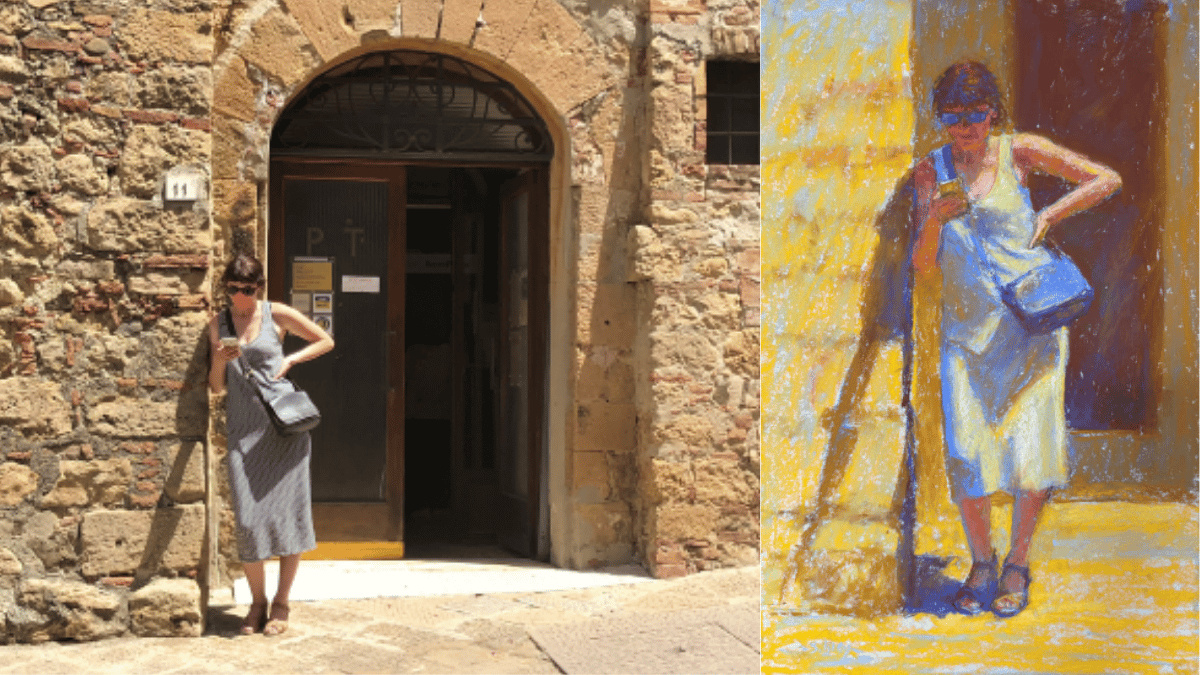
Below is a simple example of what I mean.
The difference isn’t about right and wrong. It’s about who’s making the decisions.
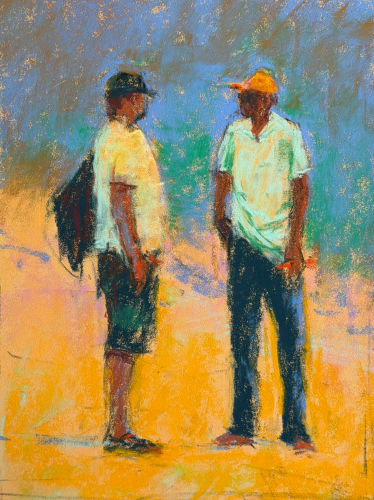
When did accuracy become the measure of success?
I think there’s something else going on too.
A painting that resembles its reference gives us a very easy way to judge ourselves. We can look from one to the other and ask: Does mine look like that? Is the nose in the right place? Is that tree the correct shape? Did I get that colour?
It’s measurable.
But what if the question is: Did I make an interesting painting?
That’s much less straightforward.
What about: Does this painting communicate what excited me about the subject? Does it feel like what I wanted to say? Did I make choices that strengthened that idea?
Those questions require more from us than comparison with a photograph.
And I wonder whether this is how we end up in that strange situation where an artist says, ‘I want to loosen up and be more expressive’, while simultaneously trying to reproduce every piece of information in the reference.
We say we want freedom (and freedom contains sacrifice and choice), then quietly hand the decision-making straight back to the photograph.
So…what IS the painting about?
This, for me, is where everything changes.
Before asking, ‘How am I going to paint this?,’ try asking:
What was it about this reference photo that made me want to paint it in the first place?
This is a question I come back to again and again: what draws you to a scene in the first place?
Maybe it was a slash of evening light across a field. Maybe it was the shape of a figure leaning over a table. Maybe it was an extraordinary relationship between two colours. Maybe it was the enormous dark mass of a tree against a pale sky. Maybe it was a feeling you can’t even put into words.
But something made you stop. Something made you think, I want to paint that.
And here’s the thing: a photograph has information, but it doesn’t have intention. The camera doesn’t know why you stopped. It doesn’t know what caught your breath. It doesn’t know what you want the viewer to notice.
The photograph doesn’t know what your painting will be about. You do.
Or at least, it’s our job to figure that out!
The camera doesn’t know that you were captivated by that band of light, so it also recorded the shed beside it, the rubbish bin, the twelve fence posts, and the scraggly bush on the right.
Perhaps some of those things belong in your painting. Perhaps none of them do.
Deciding what deserves to stay and what can go is a huge part of simplifying a scene and focusing on what matters most.
I’m not saying, ‘Change things just because you can.’ That’s not the point at all.
The point is to notice who is making the decision.
If those twelve fence posts create a wonderful rhythm that supports what excited you about the scene, paint all twelve!
But let it be your choice.
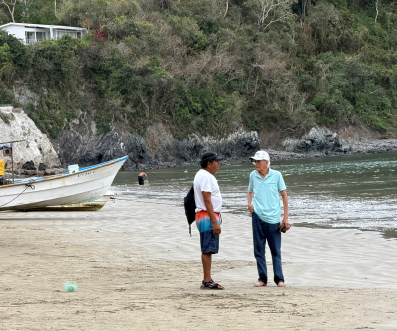
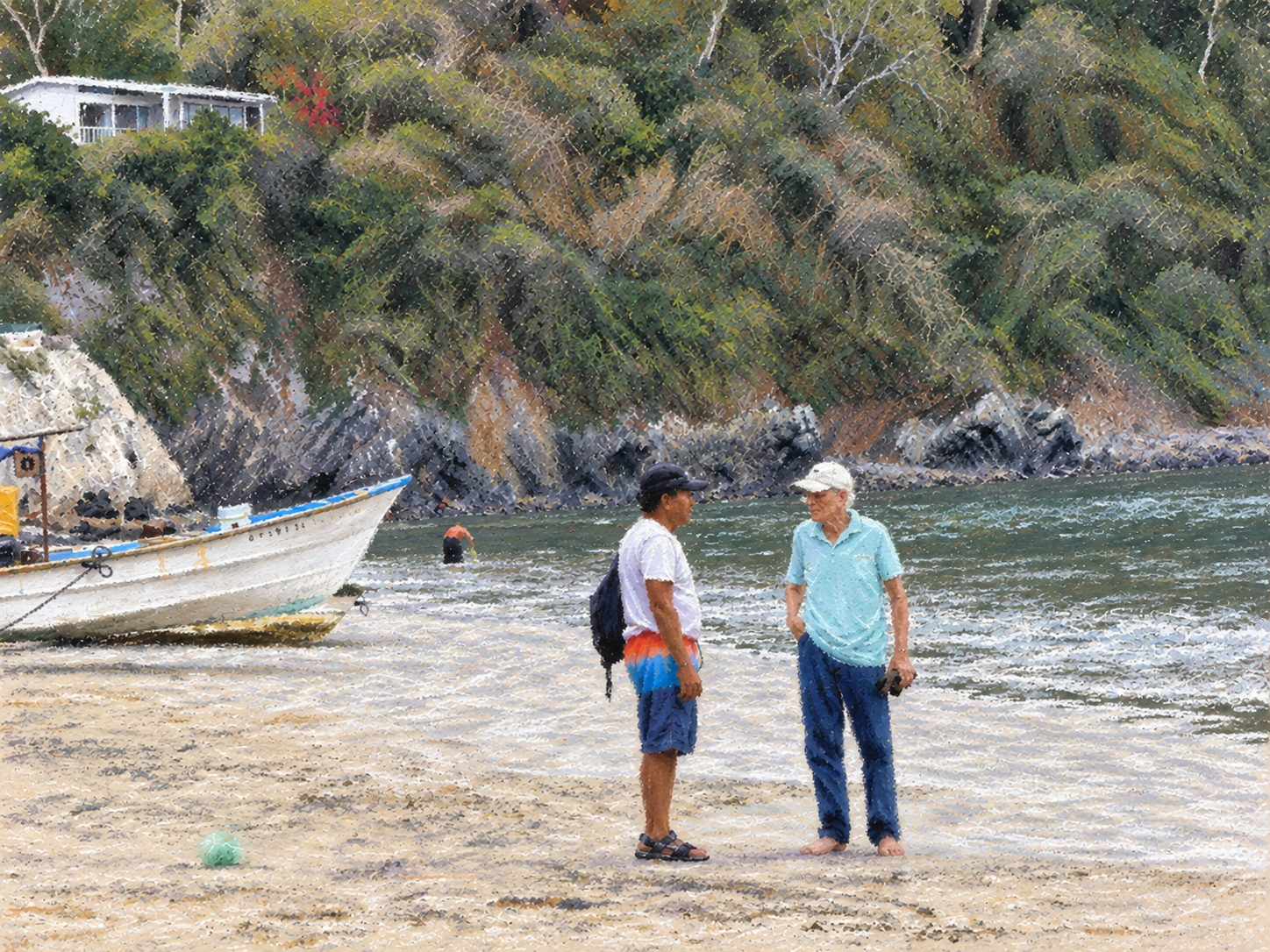
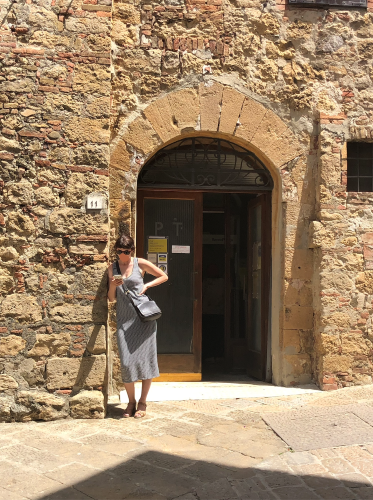
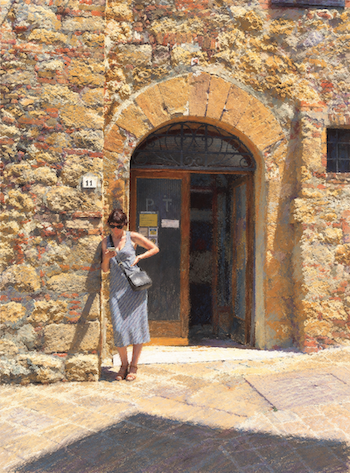
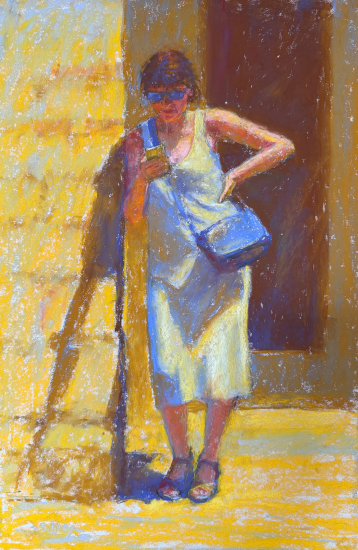
Have a look at this example – a literal copy and my painting that shows what caught MY eye!:
And somewhere along the way, look at the PAINTING
This is another place where we can get caught.
We’re looking so intently from reference to painting, reference to painting, reference to painting, that we forget something rather important.
Once you’ve begun, there’s another thing asking for your attention: the painting itself.
And the painting may need something the photograph doesn’t have. Perhaps that dark shape needs to be larger. Perhaps two shapes need joining. Perhaps the colour you matched so carefully from the photograph looks utterly boring beside the colours you’ve actually put down. Perhaps an edge needs to disappear, something needs to move, or something needs to go altogether.
At some point, the painting has to become more important than the photograph.
Instead of continually asking, ‘What does the photo look like?’, we can begin asking:
What does THIS painting need?
Try this with your next reference photo
Before you pick up a pastel, take a moment and look at your reference.
Finish this sentence:
I want to paint this because…
Don’t worry about making it profound. Just identify the thing that caught you.
Then, as you work, occasionally ask yourself whether the decision you’re about to make serves what the painting is about, or whether you’re making it simply because that’s what’s in the photograph.
You might move something, leave something out, quiet something, exaggerate something, change a colour, simplify, distort, invent.
Or you might leave it exactly as it is.
Because this isn’t about changing things for the sake of changing them.
It’s about choice.
There’s a world of difference between following a reference because you’ve chosen to do that and following it because you’ve forgotten you have a choice.
Your reference photo is information, not instructions.
Use it. Study it. Learn from it. Follow it closely when that’s what you want to do.
But remember who’s making the painting.
The photo is the starting point. YOU make the decisions.
So, the next time you pull out a reference photo, pause before you start painting and ask yourself:
What made me want to paint this?
Then keep checking in as you work. Who’s making the decisions? The photograph? Or you?
Now think about this: Where does your reference photo boss you around most? Colour? Composition? Details? Something else?
Let me know in the comments!
Until next time,
~ Gail