

When I took the reference photo for this painting, I was teaching in the small Italian hilltop village of Monticchiello. It’s the kind of place that invites looking — old stone, warm light, narrow streets, flower pots, and that sense of layers of history all around you. And it got me thinking about a question I return to again and again: what draws you to a scene?
Interestingly, it wasn’t really the village itself that made me want to paint.
It was the woman. Leaning against a wall. On her phone. Oblivious to everything around her.
There were also those gorgeous cast shadows – one created by her purse, another stretching down the wall – and that little visual jolt of an old town holding a thoroughly modern moment. I found myself wondering, with a smile, what her ancestors would make of her standing there checking her phone.
That combination – pose, shadow, and contrast – was what pulled me in.
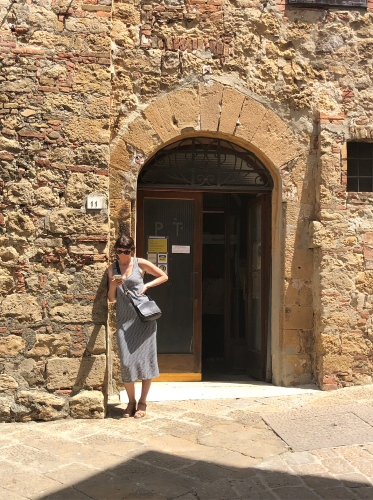
What caught my eye
One of the questions I come back to again and again when I’m deciding what to paint is this: what draws me to paint a scene?
Because usually it’s not everything.

It’s not always the whole view, or the full landscape, or every charming architectural detail. More often, it’s one relationship, one shape pattern, one gesture, one bit of light, or one intriguing idea that makes you stop and really look. Once you know what that is, you have a much better sense of what your painting will actually be about.
And just as importantly, you begin to know what can be left out.
In this case, I wasn’t trying to paint “a village scene in Monticchiello.” I was trying to hold onto the thing that first caught me: the elegant yet casual pose, the strong sunlight, the long shadows, and that old-meets-now feeling.
That knowing shaped every decision that followed.
Finding the underlying design
Before starting the painting, I did a thumbnail to get clearer on the big value shapes. For me, this is often the moment where the excitement of the subject begins to translate into something workable. The thumbnail helps strip away the noise and get to the underlying design.
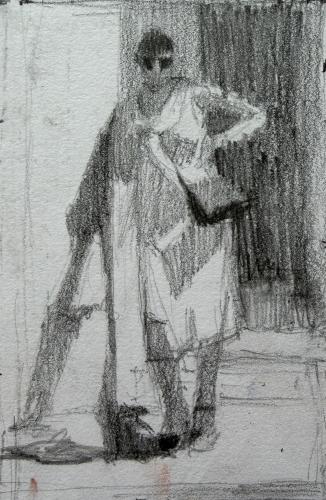
At that stage, I was mostly concerned with the large pattern – where are the darks, where are the lights, and where are the middle values? What are my choices?
For the darks I chose the background door and then small shapes of the underside of her purse, her hair, sunglasses, part of the cast shadow on the wall beside her and across her foot. These are like punctuation marks. The light – anything in light. And the middle values? Mostly those lovely shadow shapes anchoring everything. Even in a tiny sketch, I wanted to feel that strong push and pull between light and dark.
That’s one of the gifts of asking what draws you to a scene. It helps you identify the structure that supports the feeling. You stop trying to include everything and start paying attention to what matters most.
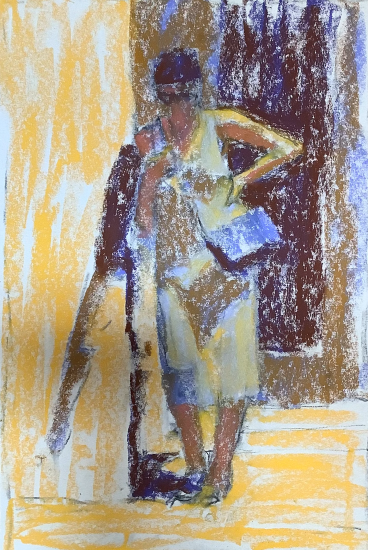
When I moved into the first layer, I was thinking less about detail and more about placing the main masses and colour relationships. I wanted the warmth of the sunlit wall, the cooler notes in the dress and bag, and the darker vertical shape of the doorway to all begin speaking to one another.
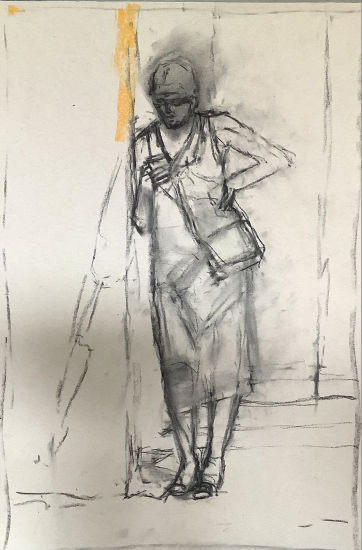
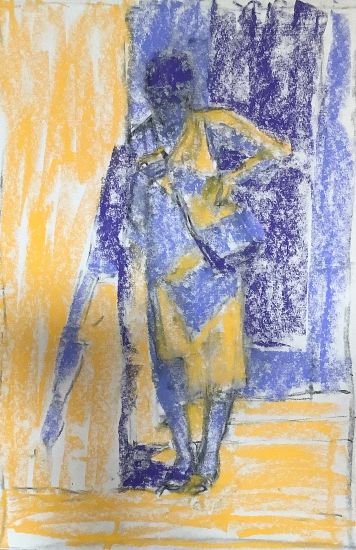
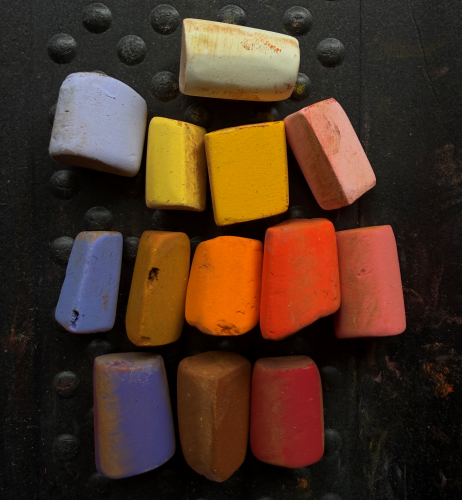
At this point, the painting was still very much in the “setting things up” stage. The drawing didn’t need to be perfect in every part, and the forms weren’t fully resolved. What mattered was getting the broad shapes and colours in place so I had something to respond to. I decided to stick with a mostly complementary set of colours – yellows and purples.
The messy middle
And then, as so often happens, came the messy middle.
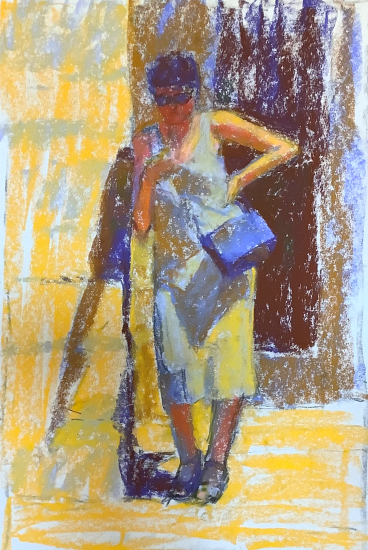
There’s that stage in a painting where things can feel awkward, unresolved, and not especially attractive. The freshness of the beginning has worn off, but the clarity of the ending hasn’t arrived yet. That middle ground can feel uncomfortable, but it’s also where the painting starts asking more of you – the commitment to stick with it and the trust that it will resolve.
Coming back to what mattered
What helped here was returning to the original attraction. Not: “How do I make every part look finished?” But rather: “Am I still holding onto what caught my eye in the first place?”
That question matters.
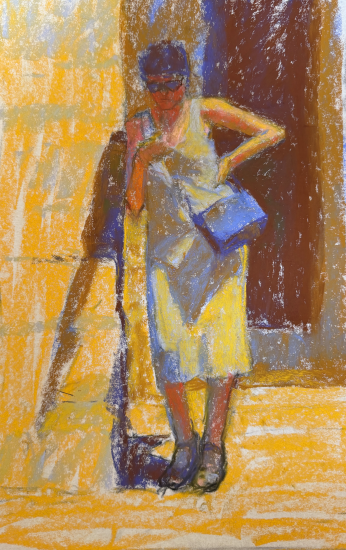
Because the temptation in the middle can be to fuss, add, explain, or over-describe. Yet often the strongest move is to come back to the original reason for painting the subject at all. In this painting, that meant protecting the pose, the shadow pattern, and the strong light. It meant not getting seduced into adding more of the village just because I could. (I was very tempted to start defining the cut rocks of the wall for instance.) The surroundings only needed to do enough to support the main idea.
That’s one of the most useful things about knowing what draws you to a scene: it gives you a filter. It helps you decide what deserves attention and what doesn’t.
As the painting moved closer to the end, I began refining what would strengthen that central pull. A few shifts in colour, some attention to edges, some clarification in the figure (especially the head and feet), and a bit of tweaking to keep the balance between structure and looseness.
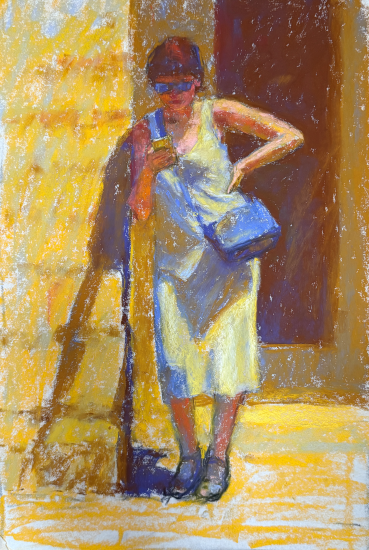
At this stage, I’m asking: what can I bring forward, and what should stay quieter? Not everything deserves the same level of emphasis. If every area is treated equally, the painting can lose its sense of hierarchy. Here, I wanted the figure and the shadow relationships to remain the stars, while the setting stayed present but simplified.
There were final tweaks, of course. There always are. Small adjustments that help the whole thing settle into itself.
And then the final painting.
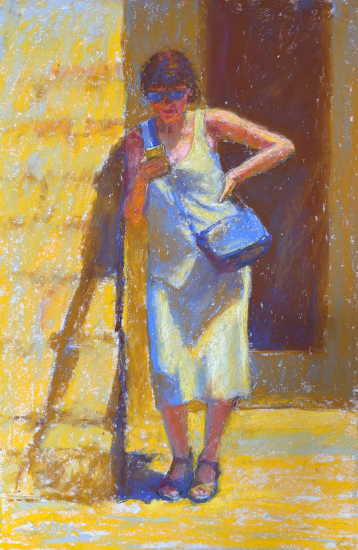
What I like about this piece is that it still carries the feeling of the moment that first stopped me. Not because I described everything I saw, not because it feels perfect, but because I stayed with what mattered most to me.
That’s the lesson I’d pass on from this painting: when you’re choosing what to paint, ask yourself, what draws you to a scene?
Is it the light?
A gesture?
A colour relationship?
A mood?
A shape pattern?
A small visual surprise?
Start there.
You don’t need to paint everything in front of you. In fact, you’ll often make a stronger painting if you don’t. Once you know what’s pulling you in, you can build around that. You can simplify with more confidence. You can leave things out without feeling as though you’re losing the scene. And you can make decisions that support the real heart of the painting – not just the literal subject.
The scene often gives you many options.
Your job as the artist is to notice what’s calling you.
So next time something catches your eye, don’t just ask, “Could I paint this?” Ask, “What is it, exactly, that’s got me looking?” That’s often where the good stuff starts.
How about you? What’s the thing that most often makes you stop and look? I’d love to hear what draws you into a scene so do leave a comment and let me know!
Until next time,
Gail












12 thoughts on “What Draws You to a Scene? This Is What Pulled Me In.”
I just recently joined the pastel society painting plein Air and learning about all the techniques in soft pastol painting. I thoroughly enjoy your blogs because they’re very helpful in determining what catches your eye and how to proceed. Your last blog is extremely helpful because when you paint plein Air you see so much it’s hard to hone in on what exactly you want to focus on. Thank you so much!
That’s so great to hear TRudy! And yes, when painting en plein air, there can be so much that grabs your attention!!
I always say when I’m teaching, go for the first thing that your notice rather than continuing to search. There will always be a ton of possibilities OR, on the other hand, nothing to paint (which, of course, isn’t the case lol).
You are incredibly inspiring! Your pastel painting is beautiful, but the source image made me think. I’ve always admired artists who can visualize more (or less) than the source. I just got back into pastel painting and set up a still life. I seem to spend so much time checking colors and the drawing that I lose the freshness of the beginning. Thank you for sharing this post.
Hi Rosie! So happy you are back to painting with pastels. And delighted this post resonates.
Yes, it’s easy to get caught up in so many things when painting. Always know that there’s another painting to do so use that thing, that WHY, as your compass for each painting. It will help you keep on track and not get lost in the weeds!
I admire you for your ability to recognize a tantalizing subject from the start. I continually struggle with that…and with not getting into unnecessary detail. I would’ve probably tried to define “the cut rocks of the wall”…which was totally needless. The colors you used really sing…and her attitude, leaning against the wall, says everything…
Thanks for your kind comments Curt.
I think your work captures so much of what you want to say! And yes, you may have worked the cut rocks into this painting (I started but realised, for me, it wasn’t adding to the reason I was painting this) and it would have said something about your vision of the scene.
Hola Gail.
Realmente tu manera de abordar el trabajo es para mí manera de ver muy positiva.
Gracias pues eres muy inspiradora.
For others to see what you wrote (via Google Translate): I find your approach to work very positive.
Thank you, you’re very inspiring.
Thanks Juan!! I am happy to hear that 😀
¡Gracias! Me alegra oír eso.
Once I was painting a silver jug in pastel – I had to analyse the color change in the silver as lines. I put them together, walked one meter away and suddenly they melted together to the finest metal – Funny while I was coming near the painting again, the color lines pushed through to my eyes!
Best Anja Weibell
Ahhhh yes, that’s exactly what can happen!! Thank you for sharing this Anja! (It seems like perhaps a comment for my earlier post: How Artists See.)
I’m cheating,- but I so enjoy the the success of it. ‘Exposing’ myself to you is embarrassing, but I’m so enthusiastic about art because of the ‘cheating’. A chance pastels workshop and I was hooked! I couldn’t believe my result after 3 hours – BUT- All I have to do is decide on the subject – take a photo – upload it to a line art app and transfer the lines using graohite or carbon paper to Pastelmat paper and there you go – it’s like painting by numbers – as I said- I think it’s cheating – but….I am enjoying the results. I think from reading your blog, however, that I can move forward. Very exciting. – Cherry
Thanks for sharing your thoughts Cherry. Very exciting indeed!!
Using tools is a great idea. Then as you develop as an artist, as you dig into discovering/uncovering what it is you want to say about a subject, the more you hone in on it and pay attention to what it is you want to say about it. Step by step…