
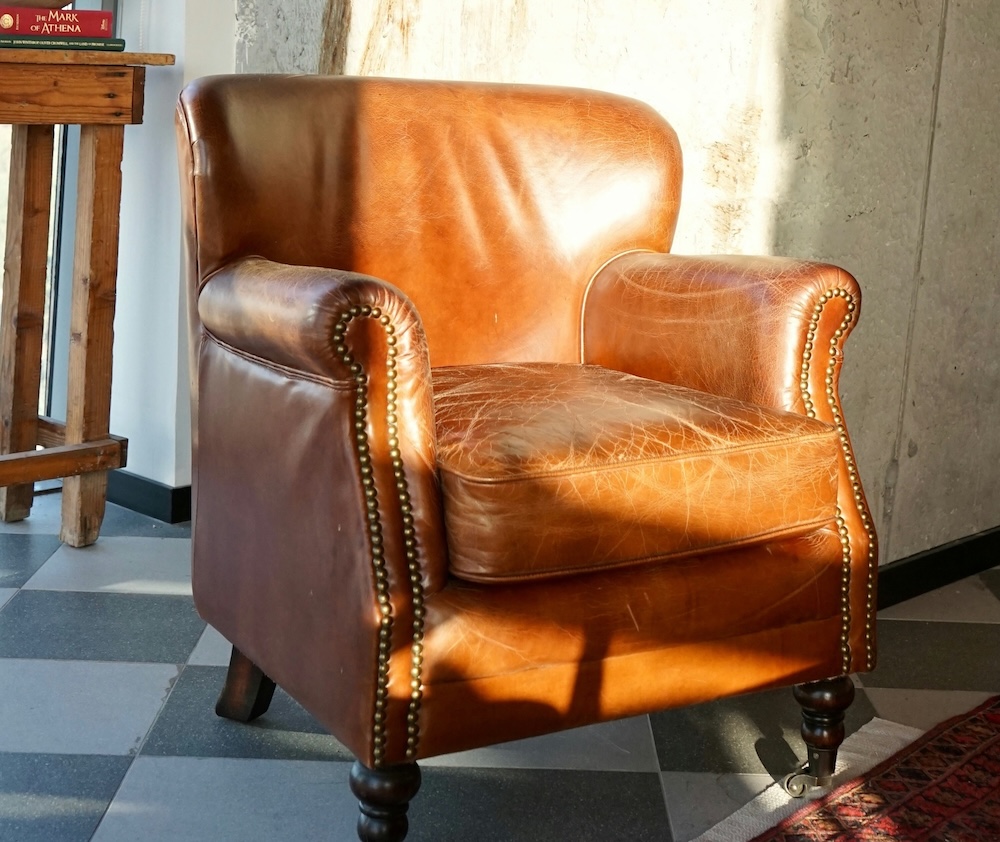
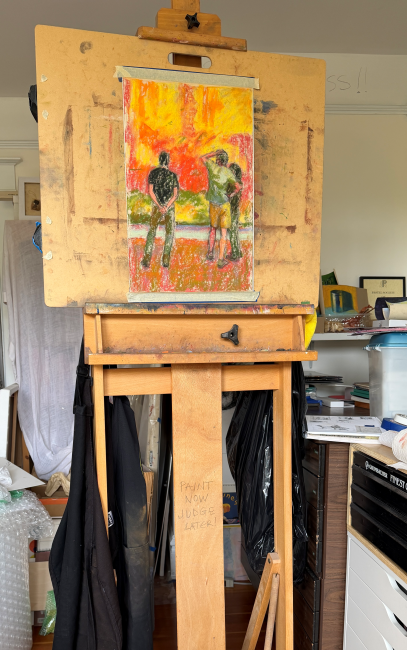
I was recently helping one of my Accelerant members think through her art studio setup. Easel? Check. Pastels? Check. Good lighting? Check.
And then I added something else to the list:
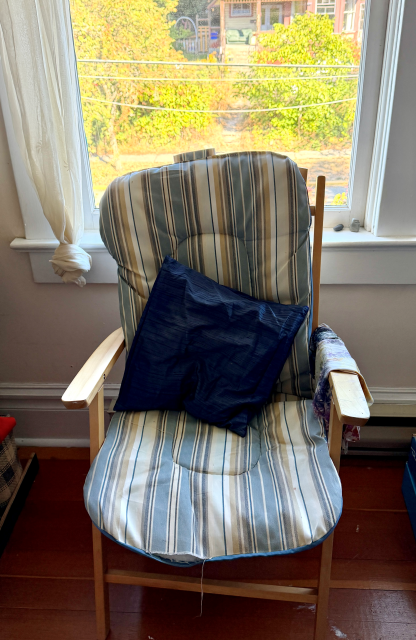
A Pondering Chair.
A comfy chair, positioned some distance from the easel, where she could sit and contemplate the work in progress.
As soon as I wrote it, I thought, Everyone needs a Pondering Chair!
Because making art isn’t only about making marks. Sometimes the work is in the looking. The pondering!
What exactly is a Pondering Chair?
It’s pretty much what it sounds like: a chair in your studio where you can sit, get some physical and mental distance from the piece you’re working on, and LOOK.

Not scroll through Instagram. Not answer email. Not read an art book. (Well, I sometimes do that.)
When we’re standing close to the easel with a pastel in our hand, we’re primed for action. We spot something and immediately go in to change it.
That edge needs softening. That shape needs adjusting. Maybe another bit of colour there…
And before we know it, we’re back in the painting when really, maybe what we need is a pause.
The Pondering Chair puts a small interruption between seeing something and doing something about it.
Distance changes what you see
You’ve heard me say it a gazillion times: Step back!
When we’re nose-to-nose with a painting, we see individual marks. From across the room, we see the painting.
We notice the large shapes, the value pattern, where the eye goes, where it gets stuck, whether one area is yelling when it ought to be whispering.
And perhaps whether anything needs changing at all.
A good art studio setup isn’t only about storage, lighting, and where the easel goes. It’s also about giving yourself enough distance to see your work properly.
Standing back helps. But sitting changes things again.
You’re no longer poised to pounce. You’ve shifted, quite literally, from maker to observer.
Looking IS part of making
I think many of us have absorbed the idea that if our hand isn’t moving, we aren’t working. Ugh.
Sitting in a chair staring at a painting doesn’t look terribly productive. But artists have always spent time looking.
There’s a famous photograph by Hans Namuth of Mark Rothko seated in his studio, surrounded by his immense paintings. I love that image!!
The paintings are there. The artist is quietly sitting and contemplating.
Looking.
Waiting.
And Rothko isn’t the only artist I came across sitting with, or surrounded by, his work. There’s a wonderful photograph of Frank Auerbach in his studio too, and then there’s Matisse’s The Red Studio that gives us another kind of glimpse into the artist’s working space itself. You can take a peek at them here: Frank Auerbach, and Matisse’s The Red Studio at MoMA.
I think the chair gives us permission.
Permission to sit. To absorb. To space out a little. Permission not to be visibly productive every second we’re in the studio.
That looking time isn’t the gap between us doing the ‘real’ work.
It is the real work.
This isn’t the Critic’s Chair
Note – the purpose of the Pondering Chair isn’t to sit down, narrow your eyes and demand:
What’s wrong with this painting?
That’s a very different chair lol.
Instead, perhaps we ask:
- What do I see?
- Where does my eye go first?
- What’s working?
- What feels alive?
- What seems unresolved?
- What does this painting need?
And perhaps the hardest question:
Does the painting actually need anything?
Because sometimes our urge to keep working has less to do with the painting and more to do with our discomfort at stopping.
The dangerous urge to ‘just fix this one thing’
Ohhhhh, we all know this one.
The painting is nearly there. We see one small thing. We’ll just fix that.
Which leads to another adjustment.
And another.
Twenty minutes later, the beautiful loose passage that gave the painting its life has disappeared beneath a series of extremely well-intentioned improvements.
Before making that next mark, go sit down. Give it five minutes. Maybe ten. Maybe twenty.
Ask whether that mark you were thinking about adding still needs to be made.
The answer may be yes. But at least now it’s a considered yes rather than an automatic in-the-moment one.
Pondering in the Messy Middle
The chair may be even more useful when a painting is nowhere near finished.
You know that stage. The excitement of the start has disappeared. Everything looks awkward and you’re suddenly quite certain you’ve forgotten how to paint. Me!!
Ahhh yes…the Messy Middle.
Our instinct is often to do more.
More pastel! More colour! More marks!
Or we think, Well, that’s rubbish. Scrap it now!
Except sometimes what we actually need is to slow down and just look.
What’s the real problem? Colour? Value? Composition? Have I lost the original idea? Am I fussing with one passage when the problem is actually somewhere else?
The Pondering Chair gives us time to figure out what the problem actually is before we start trying to fix it.
Make it a place you want to be
Comfort matters.
The point isn’t simply to get farther away from the painting. It’s to stay there for a while. So make your Pondering Chair somewhere you actually want to sit.
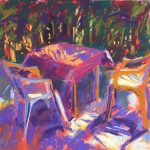
It might be an old armchair, a thrift-shop find, a little loveseat, or a paint-spattered kitchen chair that nobody else wants.
And don’t make it precious! This is studio furniture. It may collect pastel dust. It may get smudged, faded, paint-splattered or stained. All the better. Over time, it will become part of the history of your studio, there for the paintings that work beautifully and the ones that drive you mad.
A Pondering Chair isn’t furniture you’re trying to preserve. It’s a studio tool.
Perhaps the chair isn’t really the point
In the end, perhaps the chair itself isn’t the important bit.
It’s the habit it encourages.
Create. Step back. Sit. Look. Ponder. Then paint again.
So if you’re thinking about your own art studio setup, along with the easel and the lighting and all those glorious art supplies, consider making room for one more piece of essential equipment.
A comfortable, unprecious chair.
And the next time you find yourself reaching towards your painting thinking, I’ll just fix this one little thing…
Go sit in it first.
You may discover that one of the most valuable things you can do for your painting is absolutely nothing.
At least for a few minutes.
Until next time,
~ Gail















4 thoughts on “The Pondering Chair: Why Every Artist Needs One”
I love this post Gail!! I too have a pondering chair, but I never thought to call it that, it’s perfect! Though I must admit it’s more often a “checking email and social media” chair. And it’s not QUITE in the best position to view my easel (which might be the problem) but at least it gets me away from the painting for a bit and a few minutes of rest, and when I get back to the easel I feel freshened.
Thanks so muchj Rita! I’m glad you like my name for the chair….I do a lot of opondering there lol (and yes, looking at art books/mags!). I definitely try to resist using it for the dang social media etc stuff – the pull is strong though. Love that you use your chair as a break from the easel and yes, refreshed to get back to the work. I’d rather like the chair I used for the blog’s feature image in my studio…But then I might spend tooooo much time there hah hah.
Yet another very wise post! Thank you Gail. This one goes in the keeper file!
Ohh that’s so wonderful to hear Bonnie!!