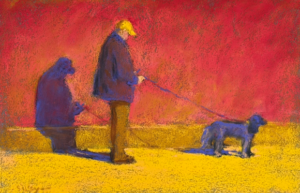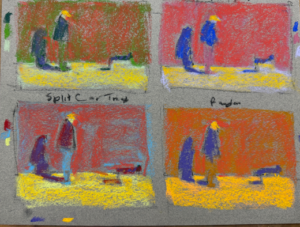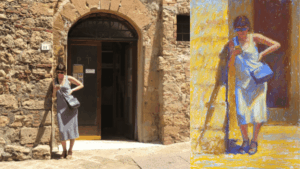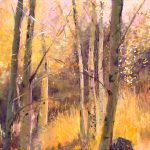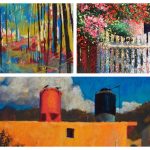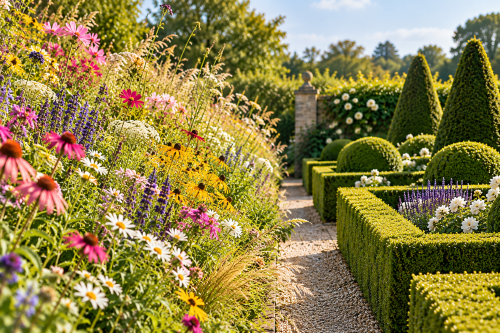
Recently, an artist I mentor shared a series of small colour studies she’d made from a landscape photograph. She’d been responding to different painting prompts during our IGNITE! October Challenge, pushing the colours, simplifying shapes, exaggerating contrasts, and generally giving herself permission to wander well beyond what the photograph was telling her.
And the results were fabulous!
These small studies were full of energy, unexpected colour choices, lively marks, and personality. There was a wonderful sense of creative freedom in painting that made each one different. I could easily imagine a couple of them popped into frames and hanging on someone’s wall.
And then she made the ‘finished painting.’
Now, there was nothing particularly wrong with this painting. It had some lovely passages. But compared with those lively studies, something had changed. The colours had become more conventional, the greens had returned, and the painting had moved much closer to the original photograph.
It was like a well-behaved child. Perfectly pleasant, doing what was expected, but without much of the personality that had made those earlier pieces so engaging.
And it got me thinking.

Why do we sometimes tame the life out of our paintings?
We give ourselves permission to play when we’re making studies. We experiment, take risks, try unusual colours, leave things unresolved. After all, it’s just a study. There’s no pressure for it to become anything important.
But somewhere along the way, we decide it’s time to make a ‘proper’ painting. The ‘real’ painting.
And suddenly the rules change.
Where does that creative freedom in painting go when we decide we’re making something that really counts?
We become more careful. We start correcting things. We return to the photograph to check whether we’ve ‘got it right.’ We add detail, readjust colours. We want the painting to look like we’ve put some serious work into it.
And sometimes, without even realising it, we paint away the very qualities that made our first attempts so exciting.
I wonder how much of this has to do with the value we place on time and effort. Surely a painting we’ve worked on for hours must be worth more than something dashed off in twenty minutes?
But why?
And who decided that a colour study was somehow less worthy of being framed, exhibited, or sold than a painting we’d spent days working on?
I’m certainly not suggesting that quick studies are always better than carefully developed paintings. Or that taking a painting further inevitably means losing its spark. Far from it! There can be enormous pleasure and discovery in sustained work.
But I do wonder whether we sometimes stop trusting our own discoveries when we shift from experimenting to producing something we consider ‘finished.’
Perhaps the challenge isn’t always to learn how to make more exciting paintings.
Perhaps it’s to recognise when we’ve already made one.
And to have the courage to leave it alone.
So here’s something to think about the next time you’re in your studio. Look at those small studies, experiments, and abandoned starts. Is there one that still makes your heart skip a beat? One that has an energy or an unexpected quality you haven’t managed to capture in your more carefully worked pieces?
Maybe it doesn’t need another layer.
Maybe it just needs a frame.
I’d love to know: Have you ever made a study that you loved more than the painting that followed? And what do you think changed? Share your thoughts in the comments below!
Until next time,
~ Gail
P.S. Of course, sometimes a study is just the beginning of something bigger! In my previous post, I shared how I took a small colour study and developed it into a larger painting, while trying to hold on to what excited me about the study in the first place. [Read that post here.]