
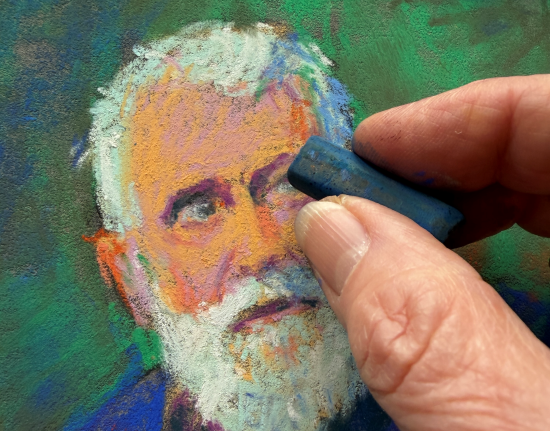
When it comes to small details with pastels, one of the questions I’m asked most often is, “How do you get those tiny marks?” Students usually assume I’ve switched to a pastel pencil – something sharp, neat, and precise. But even at the final-details stage, I’m still holding a big, chunky pastel stick. I’ve just found the particular edge or corner that will give me the mark I need.
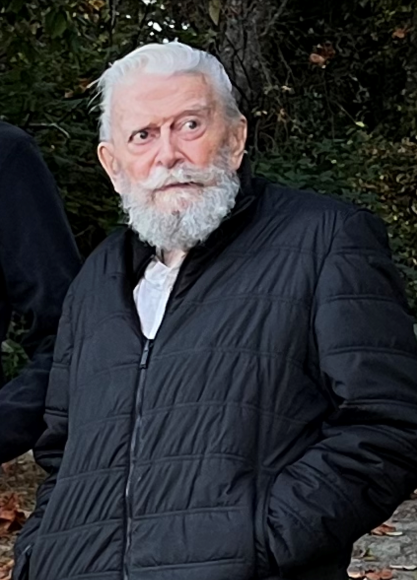
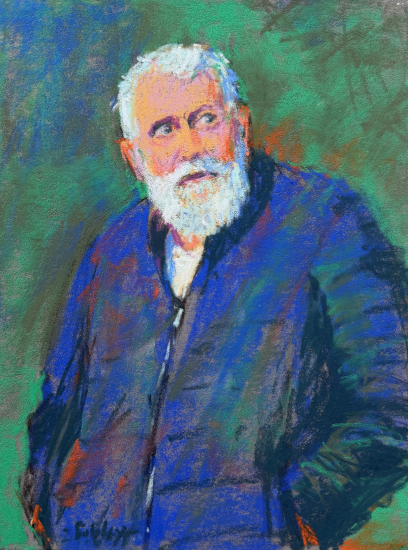
For this small pastel portrait of my friend Sandy, I began with a reference photo that looks almost black and white. What caught me wasn’t colour at all (obviously!), but the gesture: the tilt of Sandy’s head, the solidity of his body with hands in pockets, and that slightly surprised, alert expression on his face as he looks at something beyond me. That was what I wanted to hold on to as the painting developed – not every wrinkle or hair, but the feeling of that moment.
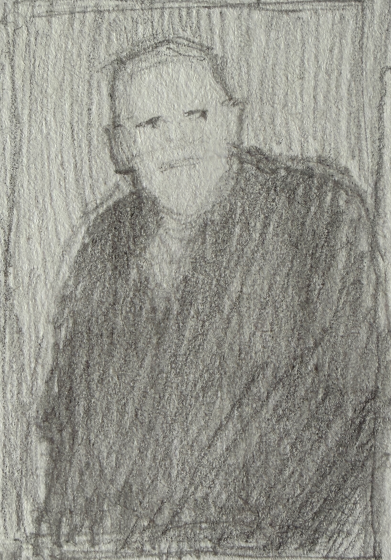
I started, as I usually do, with a small thumbnail. Before thinking about colour or detail, I wanted to understand the large shapes: the pale head and beard, the dark mass of the jacket, and the surrounding background. As you can see, I chose to lighten the background into a middle value.
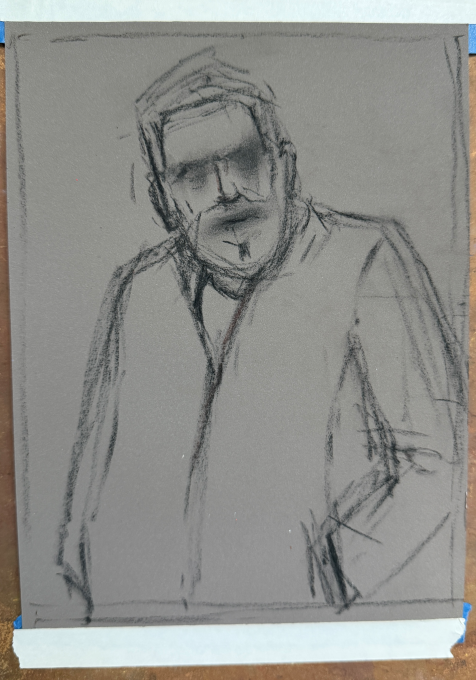
From there, I moved to a loose vine charcoal drawing on Pastelmat, keeping the marks open and searching rather than careful and final. The details could come later. First, I needed the structure, the gesture, and the big relationships in place.
With the first layer of colour, I was still thinking in large shapes. The jacket became a big mass of blue, the background a field of green, and the head and beard a pale warm shape sitting inside all that cool colour. Even though the face is where our attention naturally goes, I try not to rush into “features” too soon.
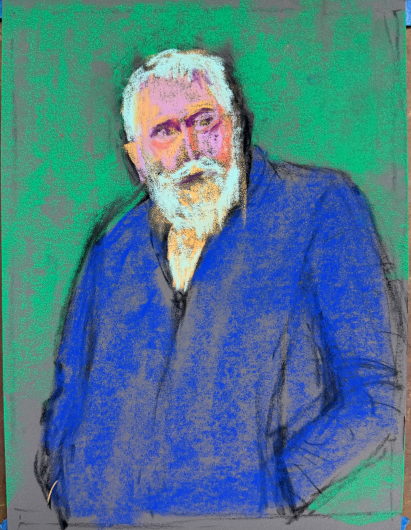
As I began working into Sandy’s face, I was looking for the expression. The eyes, brows, nose, beard, and mouth all matter, of course, but they need to serve the gesture and that slightly surprised and intense look that caught me in the first place. This is where small details with pastels begin to appear but they’re still really just carefully placed shapes and marks.
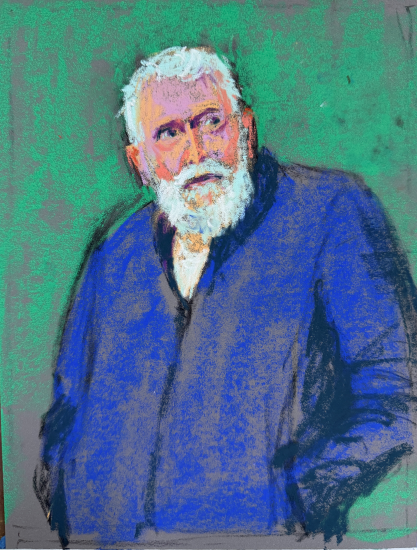
Next, I turned my attention to the background. A flat wall of one green would have felt a bit dead, so I started breaking it up with related greens and darker marks including a touch of the blue used in the jacket. I didn’t want the background to become busy, but I did want it to have enough life and movement to support the figure. I also brought some of the background green into the blue jacket.

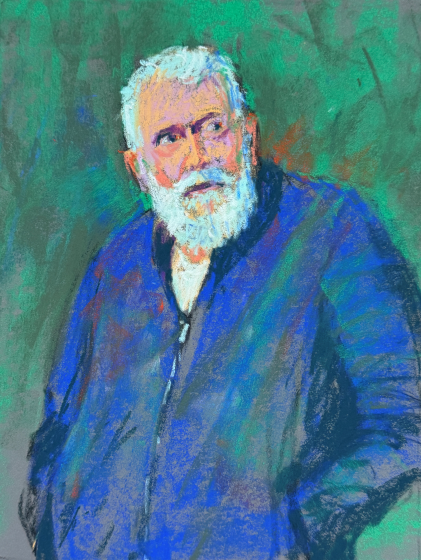
As the painting developed, I added blue into the upper left corner. This helped contain the image and keep the viewer’s eye from drifting out of the painting. The blue also visually connected the jacket and the background. I added small flashes of orange, especially lower down, to give the eye a reason to travel beyond the face and move around the whole piece. These colour echoes help connect the painting from top to bottom.
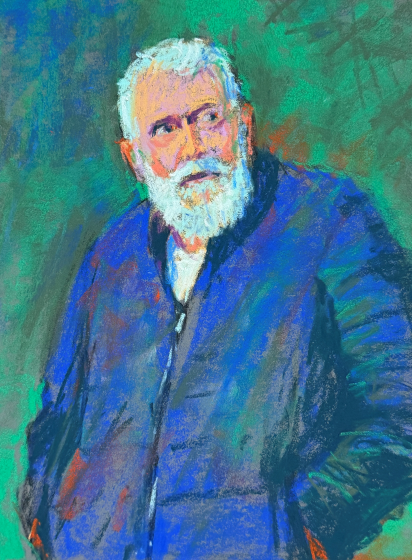
At this point, I thought the painting was finished. But when I came back to it later, something about the eye on the right bothered me. It wasn’t wildly wrong, but it wasn’t quite right So I went back in — not with a pastel pencil, but with the same big, chunky pastels I’d been using all along.
Before touching the painting, I tested the edge of the pastel off to the side so I knew exactly where the point was. That’s the trick: I’m not using the whole stick. I’m using one tiny edge, corner, or broken point. The correction wasn’t perfect, but it felt better. And sometimes “better” is good enough.
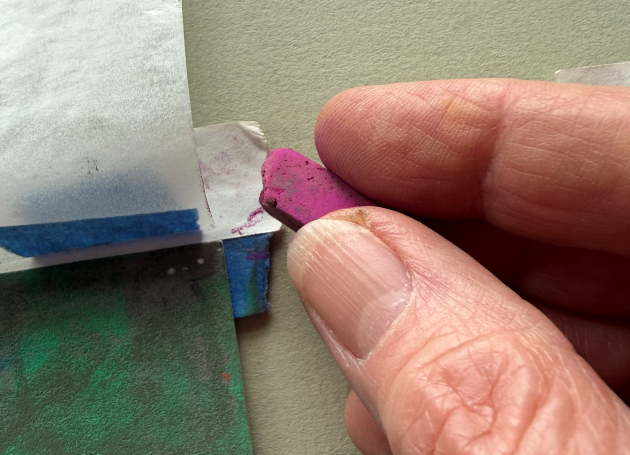
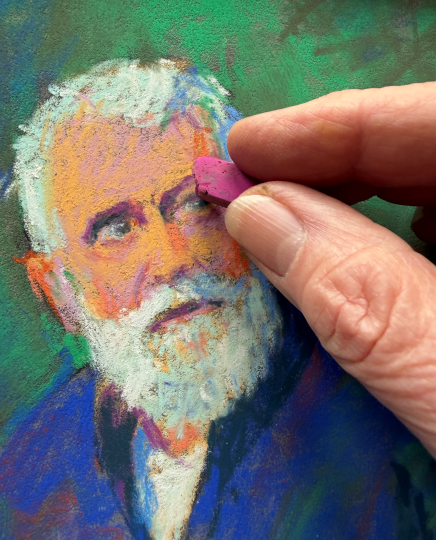
After the tweak, the painting felt more settled to me. Not necessarily perfect but closer to the feeling I was after. The eye seemed to sit more believably in the face, and Sandy’s expression still had that alert, slightly surprised quality that had caught me in the first place. That’s often what I’m looking for at the end of a painting: not a flawless rendering, but a clearer version of the original spark. And since I wasn’t trying to make a precise portrait of Sandy, but rather capture a man with an interesting expression and pose, I could let go of the need for exact duplication of features.
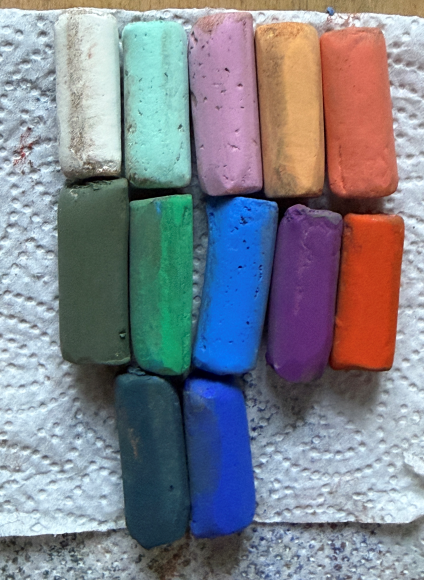
Here are the Sennelier pastels I used for the painting. They’re soft, chunky, and definitely not what most people think of as detail tools. But by turning the stick, testing an edge, and placing the mark with care, even these generous blocks of colour can create surprisingly small marks.
So yes, you can create small details with pastels even when the sticks in your hand are large, soft, and chunky. You don’t always need a smaller tool to make a smaller mark. The key is to look for the usable edge or point, test it before you commit, and be brave enough to place it.
Have you ever surprised yourself by making a tiny mark with a not-so-tiny pastel stick? Or do you instinctively reach for a pastel pencil or a harder pastel with a point? I’d love to hear your thoughts in the comments!
Until next time,
~ Gail













12 thoughts on “Painting Small Details with Pastels Using Big, Chunky Sticks”
Yes, Gail! I generally do just what you described! I often do not have the time to do a thumbnail, as my portrait sessions are only 15 minutes total, but what you did is generally exactly what I do! I am in awe of your photos describing… that would be where I would make an errant mark, trying to frame the photo of doing the thing! Great work!
I love the portrait. You are capturing exactly what you described that you wanted to capture!
So good to to hear Sue!
And yes, a 15-minute drawing is different from one where you have planning time!! You just need to jump in. But all your jumping-ins have made you very skilled at seeing the darks, middles, and lights and getting them down on paper.
And thanks for the complement 😀
Sometimes it’s difficult to let a piece be as it is – imperfect and yet, still saying something.
Thank you Gail for walking us through your process.
I also love my trustee little piece of vine charcoal to loosely find my way, lifting the excess charcoal dust with a putty erasor, and in my current WIP doing extra frantic deep erasing in sections I want kept light.
And even though I switched from colour pencil to soft pastel a few years ago and bought a small handful of pastel pencils. I had done my research and chose unison soft pastel as it seemed to be useful for underpainting and at least some detail – so it sounded like a cost effective start. There are so many types of soft pastel out there.
And I’ve pushed myself from the beginning to try avoid using the pastel pencils until I feel I have developed the hand eye co-ordination to get the marks where I want them to be, using the pastel sticks. It felt so clumsy at first, missing the mark by a mile. Fortunately I bumped my carefully kept pastels and they fell to the floor and one or two broke and I discovered what so many pastel artists mention, breaking pastels or finding edges through wear and tear…ripping off those papers, once you learn the colour names and make colour charts. Those broken slivers are my favourite/most useful tools.
I didn’t go crazy and break all my pastels…BV9 is an example of one that I use the broad side for painting sky.
And though I am striving for natural realism I still generally don’t reach for the pastel pencil aside from signing my name. And in doing so – I also find although I am now managing to get some detail using pastel sticks, I also find by getting comfortable working with chunky sticks and perhaps leaving the drawing loose to start off with, my work is becoming looser in places. I know I could go more detailed but find myself preffering some sections to be more unresolved. (Finding balance between detail and expression).
Gail, your use of bright colour to move the eye around the painting is genius. I noticed that before in your work you don’t merely rely on the composition to direct the eye.
Thank you for keeping us inspired
Hey Melanie, thanks so much for sharing so much about your own experience making small marks with pastels! I like how you say “fortunately” about toppling your pastels because as awful as that is, you discovered the silver lining 😁
And yay to your lovely comment about how I use colour to help move the viewer’s eye around the piece! Thank you!
Gail, thanks for this clearly written, documented, and very helpful article. Far too often I turn to pastel pencils for detail when I should stay with the pastel sticks that I’ve used as my base. I should probably also try softer pastels. I’m about to start on a cat portrait and will use your pointers as I move forward. Thanks!
Thanks Brooke and I’m happy to hear you will give it (staying with your pastel sticks) a try! Let us know how you get on with your cat portrait and details.
Thanks, Gail,
I enjoyed every bit of this blog although I did discover that small mark secret long ago.
I appreciated watching as you developed Sandy from the start to the end.
Many thanks!
Lovely to hear from you Wendy! I’m happy to know that you have been on the “secret” for quite some time – it makes all the difference! And glad you enjoyed the progression of the Sandy portrait 😀
Loved your tips on using chunky pastels for details. I often go to skinnier ones or pencils but will now have the courage to explore! I’m inspired. I also like your looser composition- being loose is difficult for me…. Kind of like being paralyzed! Thanks so for your artistic encouragement!
That’s so good to hear Shirley! It is tricky but practise on extra bits of paper. Guess where the tip is and then try it on paper to see how close or not so close you are.
Regarding looseness, I think setting a timer can help. And stepping back and away often!!
Thank you, Gail. I make it a habit to paint small ACEO sized paintings frequently just to practice the placement of tiny marks. Plus–it’s fun!
That’s a brilliant idea Thom! Thanks for sharing this idea 😀
I had to actually look up what is meant by ACEO and since I didn’t know, I’ll add it hear for others. ACEO stands for “Art Card, Editions, and Originals” and has a strictly standardized size of 2 1/2 inches by 3 1/2 inches