
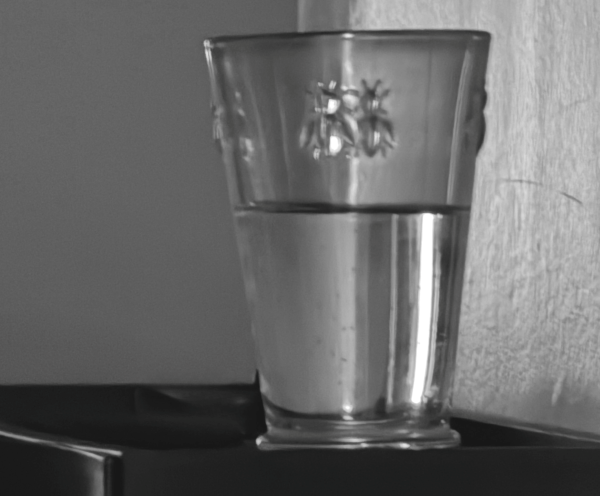
One side of the glass of water in front of me had disappeared.
Of course, the glass was still there. But its edge had almost completely vanished into the background. I only noticed it because I happened to be looking closely – something artists tend to do rather often.
Perhaps that’s part of how artists see the world differently. We notice small visual quirks and puzzles that others might simply pass by.
In fact, that same habit of noticing is probably why something else caught my attention today: this Friday happens to be the second Friday the 13th in a row!! We had one last month and here we are again. 🙃
I’m not particularly superstitious, but it did make me pause for a moment. Noticing is, after all, at the heart of painting.
And the disappearing edge of the glass was a perfect little reminder of that.
When I looked more closely, I realised what was happening. The value of the glass – or more accurately, the value of what I could see through the glass – was nearly identical to the background seen beside it. Without value difference (or an obvious dividing line) between the two, the edge simply melted away. Only a slight shift in colour temperature allowed my eye to find it again. Meanwhile, a bright highlight on the opposite side of the glass described the form beautifully.
It’s a small thing, but it’s the sort of visual puzzle painters learn to enjoy. Moments like this are part of how artists see — learning to look closely enough for edges, values, and colour shifts to reveal themselves.

Squint and see the disappearing edge!
Once you start paying attention, you begin to notice visual surprises everywhere.
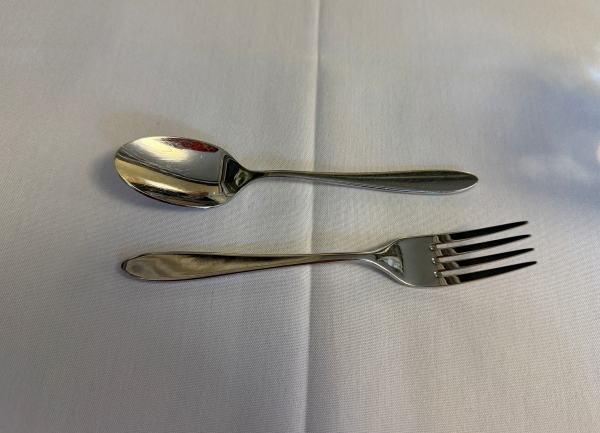
A few days ago, I noticed something cool while looking at a simple place setting – just a dessert spoon and fork resting on a white tablecloth. At first glance it seemed entirely ordinary. But the longer I looked, the more interesting it became.
The tablecloth wasn’t simply white. It was full of subtle shifts in value, hue, and temperature. And the shiny silver cutlery – which we tend to think of as light – was actually surprisingly dark in places because it reflects the world around it. Look closely and you’ll even see a bit of my Mum reflected in the curve of the spoon!
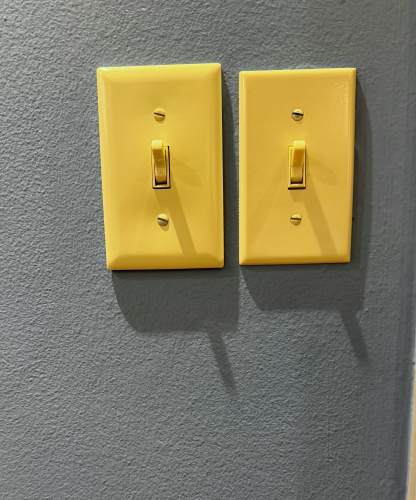
Today, while sitting in a doctor’s office, I noticed two light switches on the wall that, at first glance, looked pretty much the same. But the longer I looked, the more differences appeared. One plate was slightly larger than the other. The surfaces reflected the light differently. Even the shadows cast on and below the switches revealed subtle variations in form.
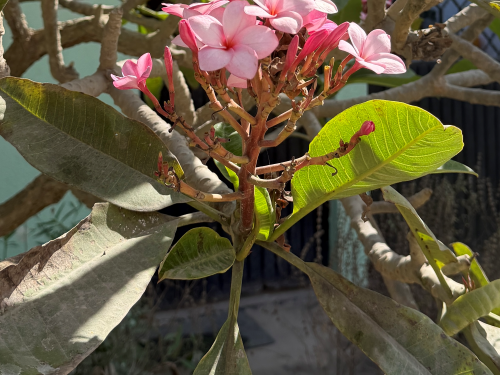
Nature offers endless examples of this kind of visual surprise as well. While in Mexico in January, I noticed it while looking at the leaves of a frangipani (plumeria) in flower. One leaf appeared pale and somewhat dull where the light struck its surface. But another leaf, with sunlight passing through it, glowed with an intense green.
The same leaf yet completely transformed depending on how the light interacts with it.
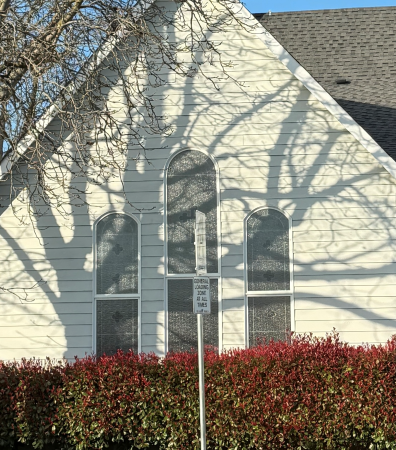
Sometimes what catches my eye isn’t an object at all, but the design created by light and shadow. Recently I noticed the shadows of tree branches stretching across the façade of a church. The organic shapes of the branches played across the hard geometry of the building, creating a striking pattern of light and dark.
It was a wonderful contrast and spiritual connection – nature’s fluid forms dancing across the rigid structure of a place of worship.
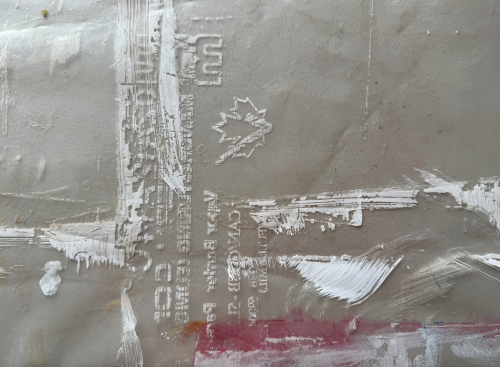
And then there are the discoveries closer to home. The plastic covering on my studio table is covered with smears, scratches, and bits of paint. One day I stopped and really looked at it. Suddenly the marks and the spacing began to resemble an abstract painting — shapes, rhythms, textures and fragments of lettering creating an accidental composition.
Perhaps that’s one of the quiet gifts of being an artist. The more we practise looking and seeing, the richer the visual world becomes. In many ways, learning to paint is really about learning how artists see. Edges appear and disappear. Colours shift. Light transforms surfaces. Shadows become designs.
Even a simple glass of water – or a few stray paint marks – can become something worth noticing.
Before I sign off, I’m curious:
What’s something visually interesting you’ve noticed lately – a colour, a shadow, a reflection, a disappearing edge?
Tell me about it in the comments.
Until next time!
~ Gail
You may also enjoy this blog post which talks about a similar topic!














12 thoughts on “How Artists See: The Curious Case of the Disappearing Glass”
I always love how sunlight shines through edges of the human body – ears and fingers (and hair) 😁
YES!!! Thanks for this visual Judy!
I’m always telling Cameron to stay still so I can photograph him with his ears so red with light coming through them.
Wow. As a complete beginner, I absolutely loved this post. Even as I am getting started, I have noticed how I see the sky, the trees, water, etc is changing (for the better) when I am on my walks. You have beautifully articulated why that’s the case and given me many other things to keep an eye out for. Thanks very much for this!!
Ohhhh Janet, I soooo love hearing this – that the post was so helpful, that you’re a beginner at the start of an amazing journey, and that you’re aware how you your noticing of the environment around you has changed. Yay!
Through the sheer curtain at my dining table, I saw a magpie scurrying along the balcony railing. A very beautiful play of light and shadow!
Ohhh that sounds magical Claudia! A view of life beyond the veil….
Laying on my belly sketching the violets realizing the huge variety if color on the “purple” petals that really go from hot pink to red violet to purple to dark blue, not even considering the center or the stem and where it attached to the bud. Super complicated actually.
Whoa YES!! Love this Sue – such deep looking. It turns out that violets aren’t just violet after all 😀
(Love the image of you lying on your belly, close up and personal with these tiny flowers!)
I like to study people in the checkout line at the grocery store. They are almost always in silhouette against the big bright windows of the store. The edges are always interesting. Wisps of hair, outfits, posture–how light and shadow can make a mundane moment intriguing and entertaining!
Hah hah, that’s marvellous Judy! Such a fun way to spend time in a queue.
Silhouettes are such a great opportunity to make tiny solid figure sketches – no detail, just gesture and body angles. And so much exprerssed!
usually when I’m at the doctor I’m too focused on my pain or just trying to get finished. I will have to learn to be more observant. My wife, who is also an artist, is also very observant. she sees color in the most subtle ways.
Even though you have pain or just wanting to get out of there (the doc’s office), sometimes focusing on looking can help remove/go beyond what you’re experiencing (pain, anxiety etc). Love that your wife sees colour in many ways. Maybe set yourself a challenge to see patterns, or differences, or spacing, or images in cracks. Anything really! See what happens on your next visit.