
Maurice-Quentin de La Tour (1704–1788) is perhaps best known for his dazzling portrait of Madame de Pompadour — a painting that seems to embody the cultivated elegance of the French court. But when I came across his pastel portrait of Jean-Charles Garnier, Seigneur d’Isle, I found myself lingering for entirely different reasons.
This is not a grand statement portrait filled with symbols and splendour. It is quieter. More restrained.
And the longer I looked, the more I began to notice the small, deliberate decisions that bring the sitter to life — decisions that have much to teach us as painters of people.
So rather than revisiting one of de La Tour’s most celebrated works, I thought we’d spend some time with this lesser-known painting (from a lesser-known museum!) and explore the subtle ways the artist creates presence — how he makes us feel that this man might turn and speak at any moment.
One of the leading portraitists of 18th-century France, Maurice-Quentin de La Tour was also known for elevating pastel from a preparatory medium to a finished and highly respected art form. His sitters ranged from philosophers (hello Voltaire!) to members of the aristocracy, including Jean-Charles Garnier, Seigneur d’Isle — an architect and garden designer of the cultivated administrative and social elite of the time.
According to the Met’s info (where an earlier portrait of Garnier resides – click through and you’ll see the sitter’s likeness is similar to the one we’re examining here), Garnier became the comptroller of the Luxembourg and Tuileries palaces in 1748, two years before this portrait was commissioned.
Though less historically prominent than some of de La Tour’s more famous subjects, this portrait of Garnier offers something especially compelling: the quiet presence of an individual aware of being observed.
Now let’s have a closer look at this portrait from the Fogg Museum.

The first thing I noticed was how at ease the sitter looks. His body faces sideways and he sits with almost a slouch – no erect back here. A formal portrait without formality. He turns his head to look at us seemingly about to say something or respond to something said with a smile. The clothes tell us about the status of the sitter but there is no other contextual info to tell us this is a member of the aristocracy. Instead, we have a man who looks directly out at us. He does look down at us slightly, which perhaps hints at his social standing.
Let’s start at those lips.
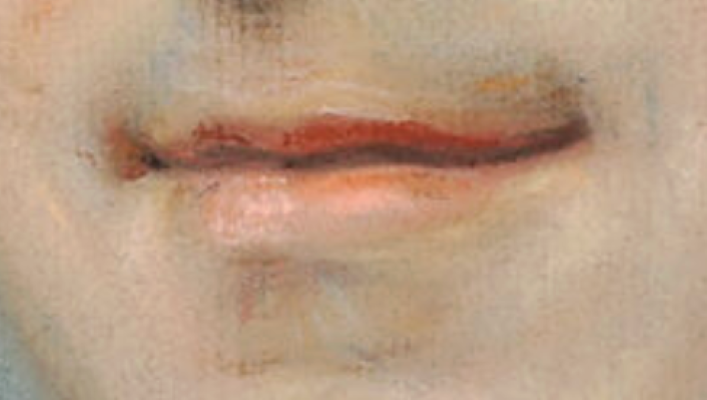
Look at how red the upper lip looks without feeling like the man is wearing lipstick. His mouth is surrounded by a subtly applied blue, hinting at the hair that, although shaved, is soon to return. There is the smallest of gaps between the lips that suggests movement. Notice how the edge of the lower lip dissolves into the surrounding skin. These lips are part of the whole and pliable rather than rigid and stuck on!
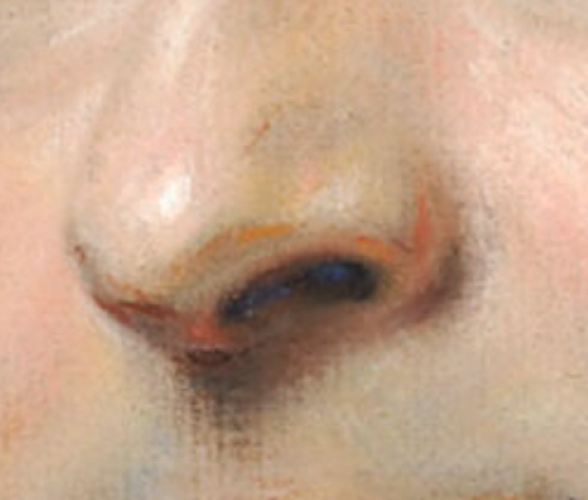
Ahhh such economy of description! The nose feels fully modelled from a distance and yet, as we look more closely, we can see how de La Tour structures the nose using colour temperature (warm versus cool) and value relationships. There is also a clear understanding of the shape and three-dimensionality of the nose. I love the restrained use of highlight and the unexpected touch of blue in the nostril. And look at the soft edge of the cast shadow.
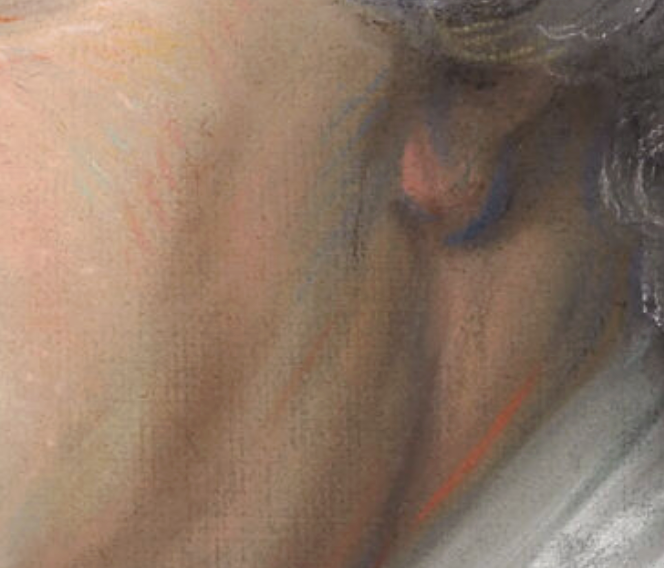
Throughout the piece, de La Tour used a brick red colour to make quiet accents. Once you notice them, you look for them! For instance, in this detail, you can see the stroke just above the collar. You can also see lighter hatched versions on the cheek over the slightly green undercolour. It also shows up in the colour on his clothing reflected from the tapestry on the chair. (See closeup below.)
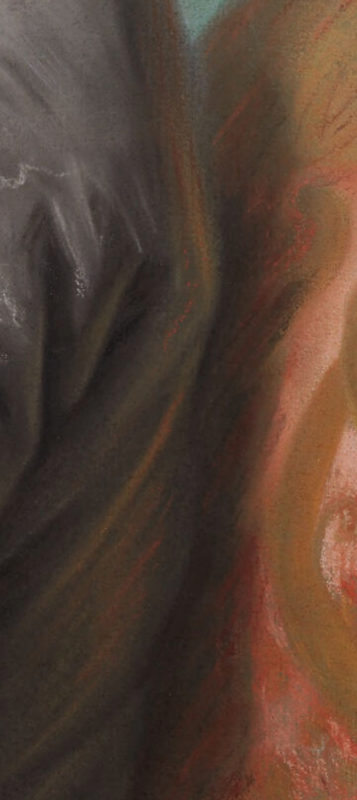
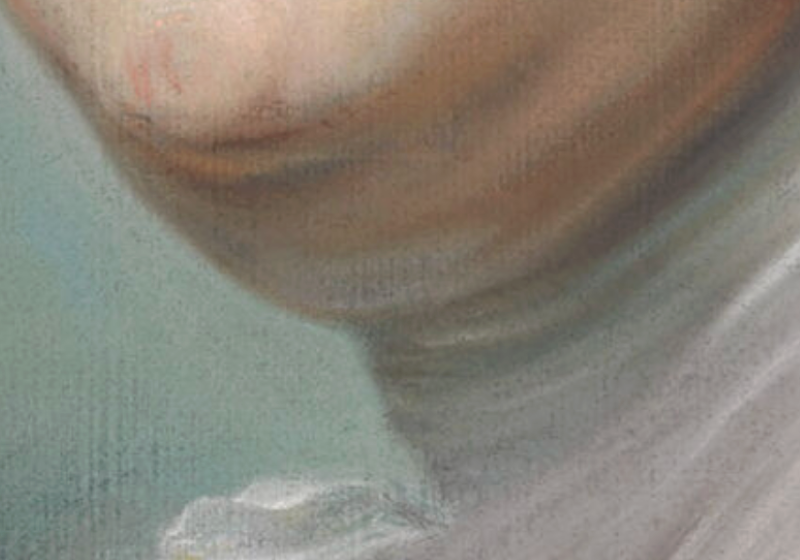
Speaking of reflected light, look at the subtle use of grey blue under the sitter’s chin – the same colour used on the material around his neck. Look at the way the artist convinces us of the rolls of flesh under Garnier’s chin.
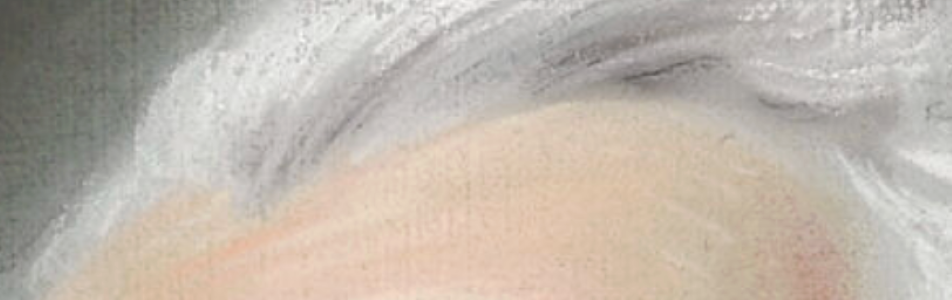
We can tell the sitter wears a wig because of the way the artist shows how the “hair” connects to the hairline — it’s a hard edge rather than the more natural transition of growing hair. There is no attempt to blend skin and hair.
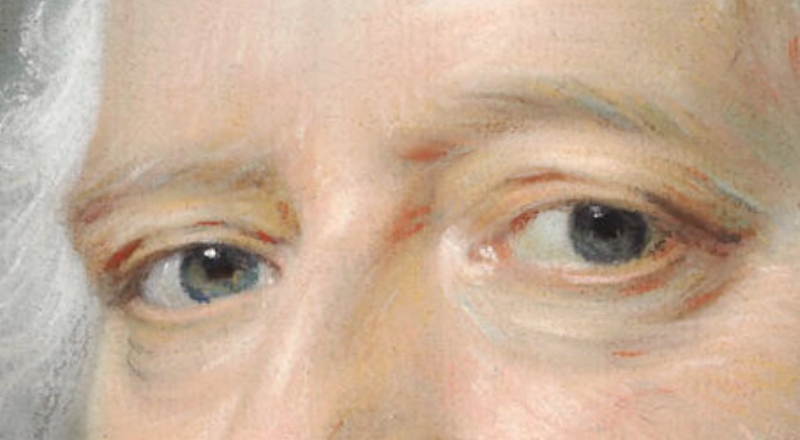
Okay, before looking at the background, let’s look at those eyes! Look at how de La Tour makes them different! Notice which eye you look at first – the one closer or the one further away?
Although smaller, the one further away has the clear highlight. It also has slightly harder edges on the lid. There’s a clearer value separation between the sclera (white of the eye) and the surrounding parts. And we have a stronger sense of the roundness of the eyeball. The forward eye is just a whisper, less resolved. These subtleties guide us to look at both eyes rather than glaze over eyes that merely repeat.
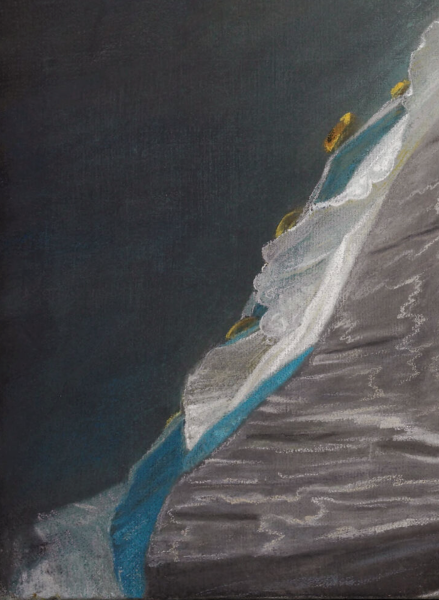
Let’s have a look at the way de La Tour creates the illusion of different fabrics. We already had a sense of the brocade on the chair (in the reflected light example) so let’s look at three other types of material – the velvety and brightly coloured waistcoat (barely visible), the lacy ruffles, and the silk moiré jacket. How does he make them look different?
The turquoise velvety fabric has no highlights which is completely the opposite of the grey coat. Those crazy zigzags of light grey dazzle us! The frills have a transparency and look at the way the artist defines the edge with a sharp white line in places. Notice how little the frilled cuff lower left is defined, making sure our eye doesn’t linger long.
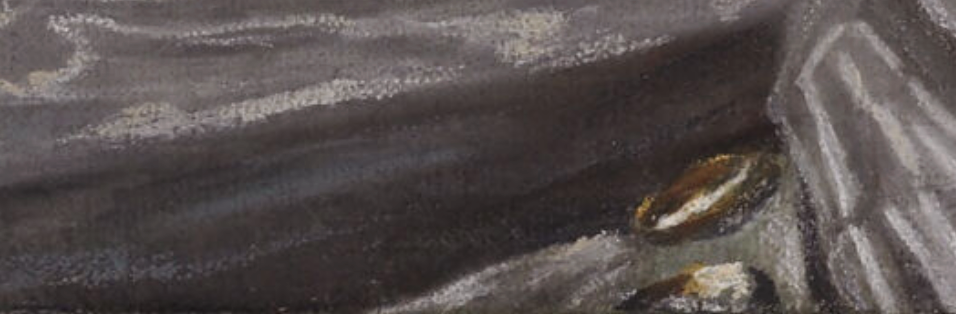
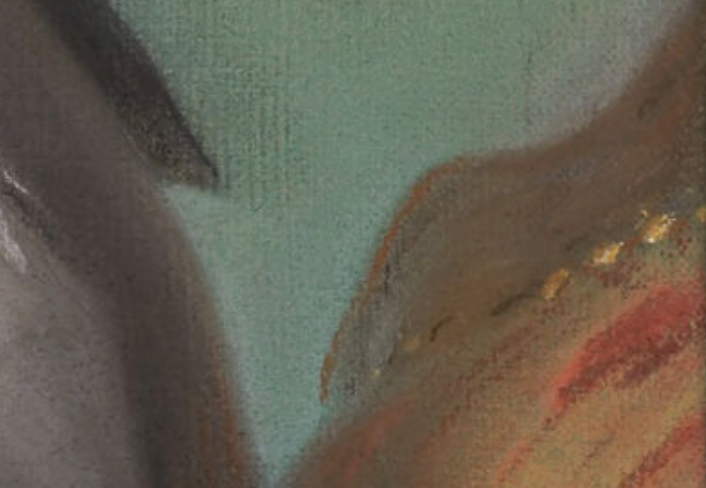
The gold buttons run down the front of the outfit but examine how little is there to suggest buttons.
The buttons of the cuff are even less noticeable as are the upholstery pins on the chair. But they are there just the same and we do see them if we take the time to look!
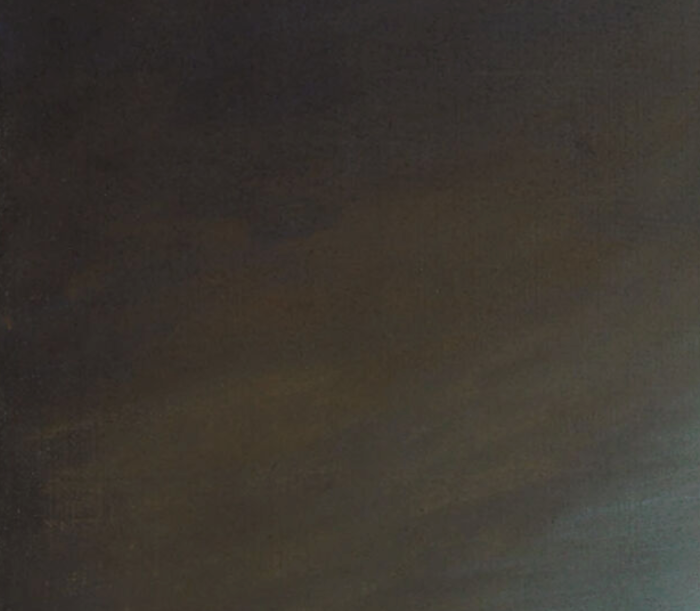
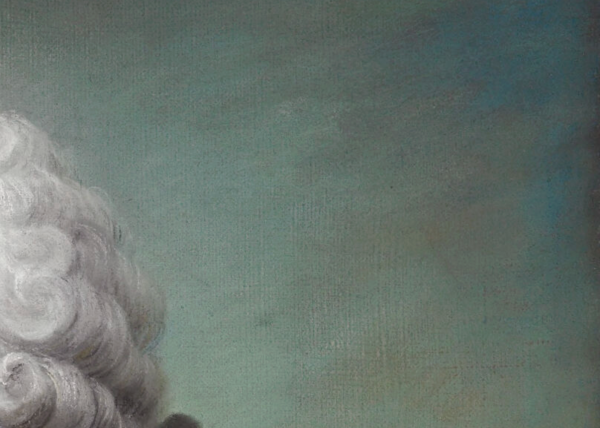
Now let’s examine the background and how de La Tour uses it as a compositional support (disguised as atmosphere). Notice how the background is lighter and more obviously “active” nearer the head and quieter and darker towards the edges. The brighter lighter background advances the head – it subtly (until you notice what’s happening) frames it.
The dark parts have a number of colours present, all dark values, which creates interest.
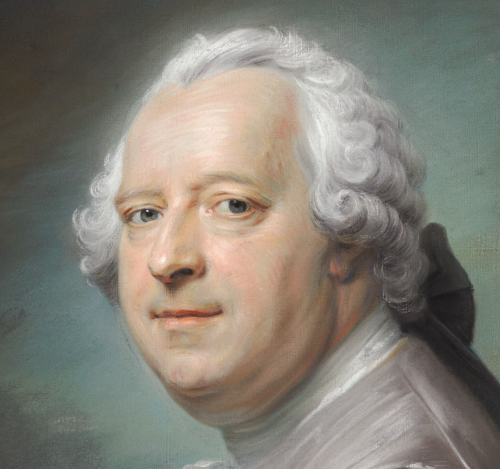
Look at the way de La Tour treats the edges of the head and clothing where they meet the background or within the shape itself. The contours seem to dissolve rather than end abruptly. This puts emphasis on the features of the face ie the important bits!
Two more things to point out.
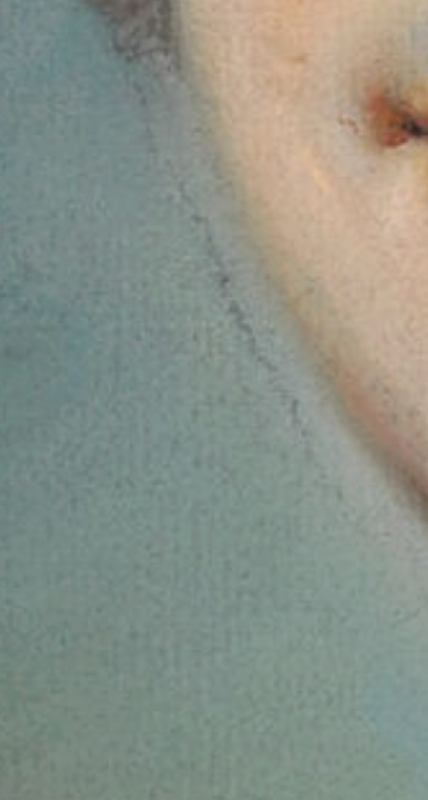
I’m always interested to see the hand of the artist at work and one of the things I’m always on the lookout for are remnants of the preparatory drawing. You can usually only see these with close looking. Here we see what looks like a faint line along the cheek that reveals a trace of the original drawing.
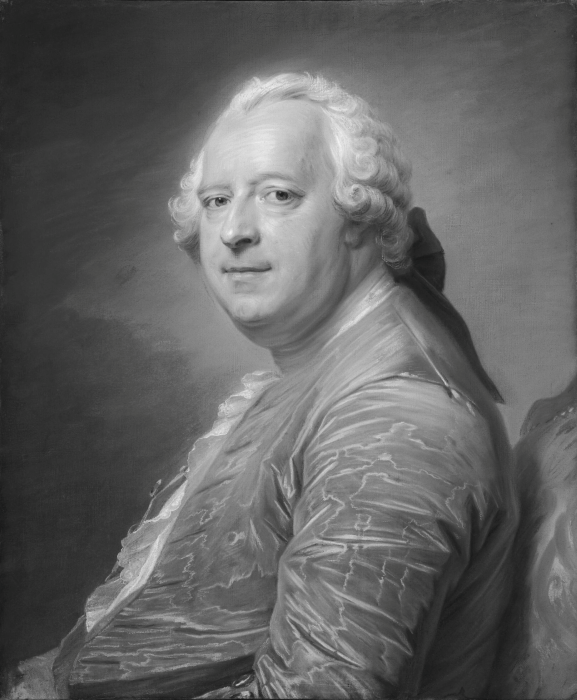
And finally, you know me, I’m interested in the underlying value structure and what it shows us. Here you can see how the dark areas (background on the left, the dark wig ribbon, the shadow between his back and the chair and the slash of dark at the bottom) all frame the subject. The light is on his face and the line leading up his clothing to the head.
Let’s have a look at the whole painting again.
I think what makes this portrait so compelling is that it offers more than a likeness — it gives us a sense of the man himself. Through the turn of the head, the measured engagement of the gaze, and the restrained way his finery is revealed, de La Tour suggests the man’s awareness rather than being on display. We feel that Garnier has noticed us and chosen to meet our glance. The pose is not simply arranged; it feels inhabited by this human being.
The subtle hierarchy in the features, the quiet animation in the mouth, the presence that seems to extend beyond the moment – all combine to create the impression of someone who exists beyond the paper. This is what it means to capture essence: not to show what someone looks like, but to make us feel what it might be like to be in their presence.
Sooo I’d LOVE to hear your thoughts about this portrait. Did you have any ahas or takeaways? What do you think the subject might say? What other things do you notice? I’d love to hear anything you’d like to comment on!
Until next time,
~ Gail
PS. Click here to see Maurice-Quentin de la Tour’s most famous work
PPS. Quick note: Maurice-Quentin is the artist’s full first name – a common double given name in 18th-century France – while “de La Tour” is his surname.
PPPS. After publishing this post, I came across this in-depth study about Maurice-Quentin de La Tour’s life and work by Neil Jeffares. I have yet to read it but did want to capture the link here!!
PPPPS. PPPS. I was unable to find a good image of the third painting of Garnier at the Musée des Beaux-Arts Antoine Lécuyer but I did find night time image of their facebook page. You will see that this painting is of Garnier’s head and shoulders only.








![Pastels on black aper: Gail Sibley, "Untitled [at this point], Mount Vision pastels on Sansfix pastel card, 5 1/2 x 7 3/4 in](https://www.howtopastel.com/wp-content/uploads/2016/04/IMG_9649-2-150x150.jpeg)


10 thoughts on “Maurice Quentin de La Tour “Jean-Charles Garnier” – A Close Look”
Gail, an informative masterclass in portraiture. Thank you. I am going to incorporate several of your observations in a self-portrait I am currently attempting.
Hi Brooke, This is so great to hear. Of course I’m very curious which points stood out and will incorporate into your self-portrait!
I especially like your observations on the eyes and lips, Gail, and will try to be mindful of them when next I attempt a portrait. I swear I can see the sitter breathing!
Hah hah. Breathing…exactly!! Glad the lips and eye notes were helpful Beth 😀
Thank you Gail, for the indepth study. You certainly made me observe points that I hadn’t noticed. Glad there were a few tips to take away.
That’s grand to hear Nola! I just love taking a close look at paintings that catch my attention and it’s good to hear it’s useful 😀
Awesome examination of de La Tour’s work. I am blown away at the detail and subtleties on face and fabrics. Thanks sooo much Gail for sharing. Really enjoy and learn a lot from your insights!
You are soooo welcome Lindsey!!
When we slow down and look deeply at a painting that catches or eye, it’s amazing what we can discover about how an artist creates the illusion of reality, and what we can take into our own work.
thanks for this up close and personal examination. the oil portrait painters of his time actually felt threatened by him and his medium, pastel, because he was so good. I was looking for the joints between the paper but I could not find any. Perhaps he used only one large sheet. they often glued multiple sheets to the canvas.
the other point I would like to make is that, while we admire these artists for their excellent work, their craft, their main goal was to capture the persons likeness, much like a portrait photographer would do today. If they could not capture the likeness and do so in a way that dignified the sitter, these artists would be out of work. there main goal in painting was not to paint their own personal artistic expression. that is not to say they did not incorporate their own artistic style. clearly this artist did. but the focus in the modern art world is much more about personal expression and less about capturing a visual record of the person for future generations. Need I only mention the portrait of king Charles with the red background!
I hope this comment was not too far off track. Thanks for your contribution to the world of pastel.
Thanks so much Wayne for your thoughts and inf Wayneo. Not off track at all!
And yes, you’re right regarding the main objective being to capture a likeness. The greats do that and then more! I’ve linked to the two other commission de La Tour did for Garnier and this one is the painting I think that captures that extra something.
Regarding the controversial portrait of King Charles by Jonathan Yeo, yes, it is modern. I do, however, think that Yeo has captured the likeness of Charles as well as painted something beyond an expected and a more conventional portrait. I think it was brave and telling that Charles commissioned this artist to do his formal portrait.