
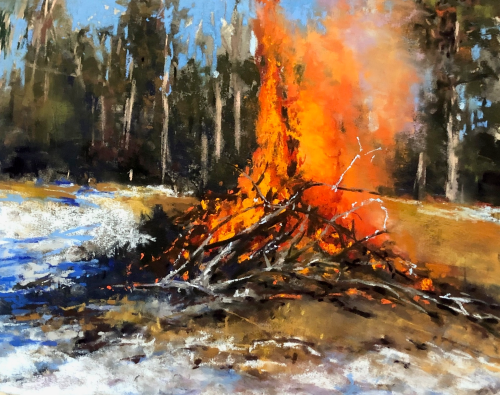
I was cruising through my social media one day and was stopped by the painting of a blazing fire. Oh wow I thought! The pastel was by Beth Tockey Williams and I got curious. I checked out her website – more fire paintings (among other subjects) and I decided there and then to invite her to the blog to share her beautiful fire paintings and talk about her process. A perfect subject as we, in the Northern hemisphere, head into the cold of winter.
I think you’re going to swoon, or at least feel the heat, when you see these fire paintings by Beth Tockey Williams.
Before we get into her guest post, here’s a wee bit about Beth.
Beth Tockey Williams Bio
Beth Tockey Williams is an award-winning artist and signature member of the Pastel Society of America (PSA). She served as the 2019 Artist in Residence at the Dry Tortugas National Park. Beth earned a Bachelors of Science degree in Art Education from Texas Tech University, and has taught art for private and public schools, as well as for art museums. Her work has been featured in the Pastel Journal, and she achieved master circle status with the International Association of Pastel Societies (IAPS) in 2021. To see more of Beth’s work, check out her website.
And now, here’s Beth Tockey Williams to talk about her fire paintings!
~~~~~
Laying the Groundwork
I came to pastels after a 15-year break from my art practice. The voice to create was always there and once my children were more independent, I returned to painting. Previously, I had worked in watercolor. After seeing a beautiful pastel painting hanging in a gallery window in Charleston, South Carolina, I decided I would try something completely new.
After some frustrating starts and a stubborn desire to keep trying, I eventually overcame the learning curve and embraced pastel as my medium.
I enjoy the pure luminous color quality and the ability to paint and draw within the same piece. I am impatient by nature, and I love that with pastel, I’m not mixing colors and cleaning brushes after each painting session.
Nearly all of my early works were products of the landscape of the South Carolina Low country where I live, the salt marsh and marine environments are an endless inspiration. I spend a great deal of time outdoors enjoying the beauty around me, it’s where I feel most at peace. My work has evolved to include a connection between nature and art as a means of healing. I begin all of my paintings en plein air.
Only one year after I returned to my painting practice, I lost my teenage son. My art practice shifted to art therapy and it has been a constant source of comfort in my grief.
Art as an outlet for grief extends throughout my family.
My daughter Hailey, a writer, and I were awarded an artist residency by the National Parks on the subject of healing grief through nature and art. We spent a month at the Dry Tortugas National Park, living in complete solitude off the grid. I painted and Hailey wrote poetry. We felt at one with nature, our creative talents, and each other. We spent that time healing together, a labor of love that brought us closer and enriched us as artists.
We partnered our creative work in an ekphrastic exhibit entitled “Seeking Solace,” where each painting was paired with a poem. Poetry continues to inspire me today, and I often find myself reflecting on how the writing process and visual art cross-pollinate.
The most regretful people on earth are those who felt the call to creative work, who felt their own creative power restive and uprising, and gave to it neither power nor time. ~ Mary Oliver.
Recently, I have established a secondary painting studio in the mountains of western North Carolina. I’ve begun painting waterfalls and mountain ranges. I look forward to adding them to my repertoire. I hope to participate in more artist residencies, perhaps in the Southwest for earthy rocky elements or colder regions with snow and ice elements.
The Subject of Fire
The idea to paint fire came to me during the COVID-19 pandemic. With everything shut down, I was stuck in my home on Edisto Island, and suddenly had a lot of time on my hands.
After cleaning and organizing my entire home, I began clearing my rural property. I gathered fallen palmetto fronds, oak branches, and other debris that had accumulated over time from strong Atlantic winds, and piled it up for a bonfire. I couldn’t take my eyes off the flames, responding to their meditative quality. I wanted to capture that feeling of calm and awe.
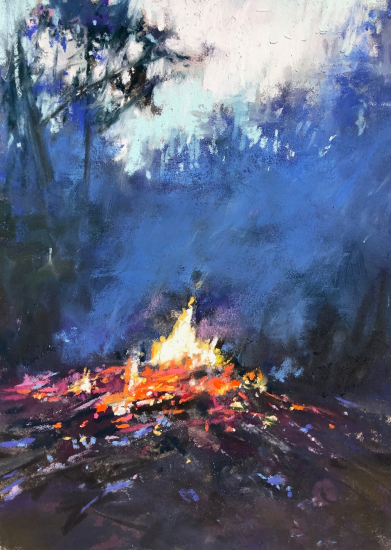
There are various stages of a fire and each can be separate subject matter. For example, the first stage is when the flames are first getting started and there’s a lot of billowing smoke that creates a lot of color and transparency.
The second stage is once the flames have caught you now have directional movement and vibrant, warm and rich contrast.
In the third stage, the flames begin to die and the focus is on the embers. They create brilliant colors and texture with the ash on what remains unburned.
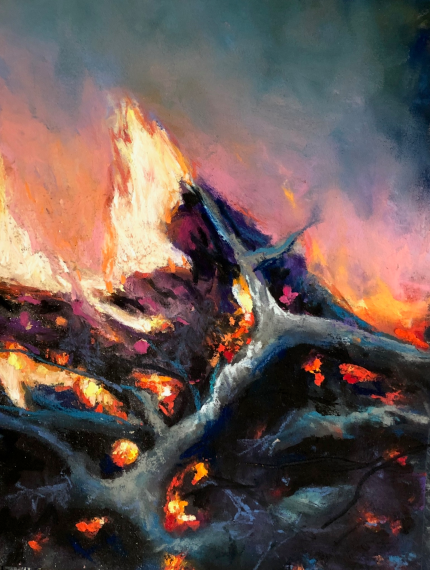
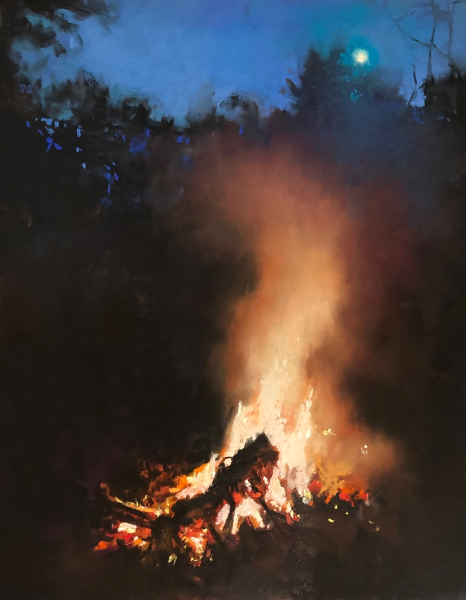
Another thing I love about painting fire is the light it casts on the ground and surrounding environment, leading to a lack of detail and added mystery.
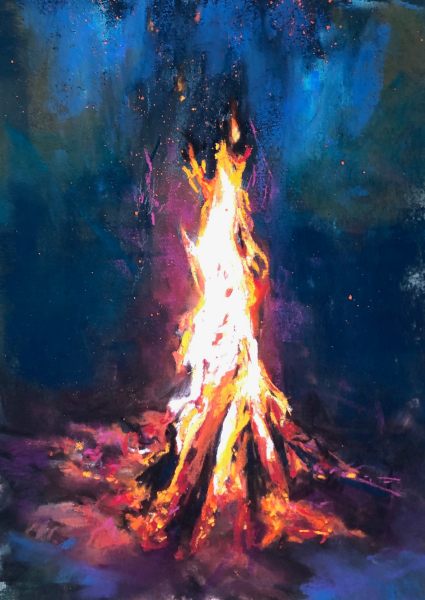
Fire continues to inspire me due to its strong appeal of contrast. It entices the viewer to engage—it’s dramatic: warm versus cool, dark versus light, dull versus vibrant.
Starting small with 5×7 in supports, I used the reference photos I took while clearing my land. That year iPhones upgraded their cameras to offer a nighttime setting. This allowed me to take sharper and more detailed photos of the flames at night. The former option would not have allowed for nearly as detailed an image; they would’ve been much darker, nearly black.
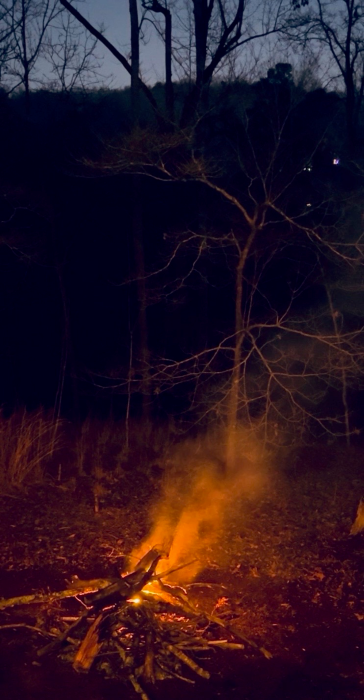

When approaching a new subject matter, I prefer to work in a series. This allows me to experiment and try different approaches and techniques. For example, the first fire paintings didn’t have an underpainting, but rather started with a charcoal sketch. I also experimented with dark UART sanded paper, but I’ve found building values up from the darkest colors in the scene is more effective in creating a realistic atmosphere.
Over the years the series has evolved to include the surrounding environment, whereas the first flame paintings focused almost entirely on the fire itself.
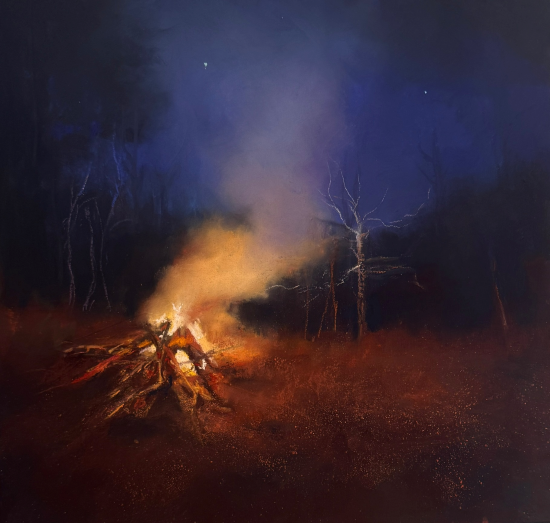
A fire painting is usually a nocturne, which means the colors are usually cool and of a darker value, which contrasts with the warm colors of the fire and its embers. The background has little to no detail and mostly soft edges.
Controlling these edges is a challenge.
Another challenge is keeping the areas of warm and cool “clean” of each other, so as to avoid making mud. To help with both of these issues, I use clear gesso to fix the cool darks of the background in place, and I keep the area of the lightest light of the fire clear of any dark or cool colors.
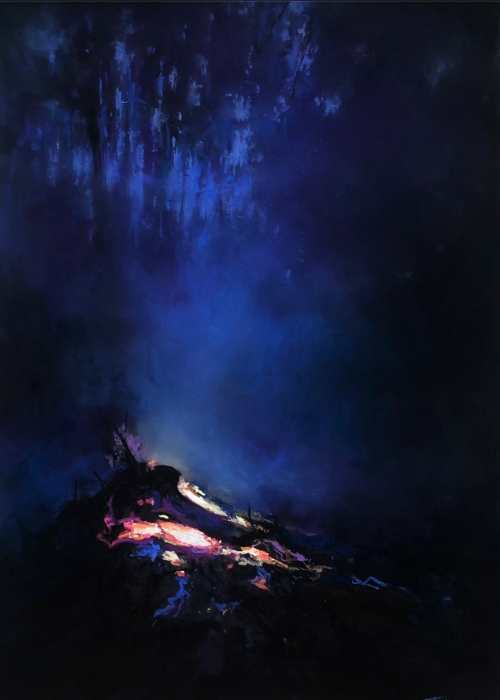
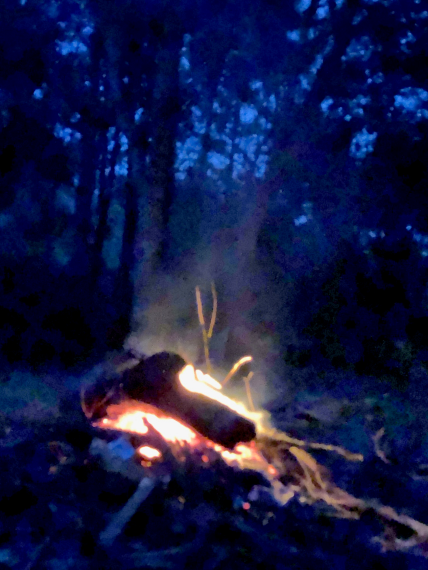
Another step in the evolution of this series was capturing smoke. Smoke includes an array of colors and lends itself perfectly to the pastel medium. When the fire is complete, I work on the last layer of smoke rising from the fire. I lightly add a thin, transparent layer of pastel on top of the background, and carefully soften the edges between the background and the smoke.

The series has grown to include a wide range of sizes, the largest of which is 24x18in. After years of experimenting, I now have a general process for my fire paintings that provides structure but allows for variation.
How to Build a Fire with Soft Pastels
Step One: Build a fire and observe
I find that building a fire directly on the ground, not in a fire pit, gives me a better result for a stronger composition because it avoids having the horizontal line of the fire pit obstruct the diagonal lines in the composition. When the ashes, sticks, etc., are actually touching the ground, it gives a sense of connection to the piece that doesn’t feel restrained. It’s much more natural looking.
After the fire has been built I prefer to video the fire from different points of view, to capture a sense of movement and place. One of the observations that surprised me is the wide variety of color present in the embers, the flames, and the smoke, colors ranging from pinks and purples to blues and greens. The video allows me to edit the moment of movement I wish to capture.
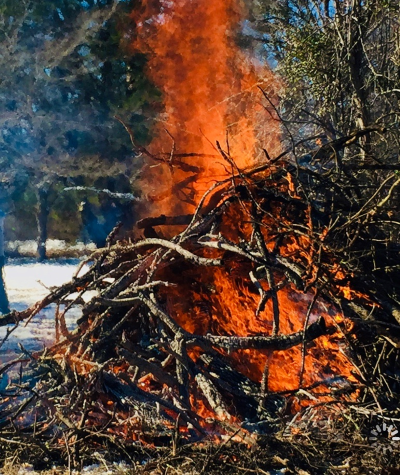
Step Two: I start with a light charcoal sketch of the large shapes of the composition
Then I do an alcohol wash underpainting, careful to separate the cool and warm colors. I slowly build the background, working from darkest values to lightest values in the cool background colors.
Once the background is complete, I apply a layer of clear gesso to fix the background in place before I begin working on the foreground. Once the foreground is complete, I spray it with Sennelier Latour fixative, and begin working on the fire itself. I locate the darkest-value color in the fire and gradually build to the lighter values of color.
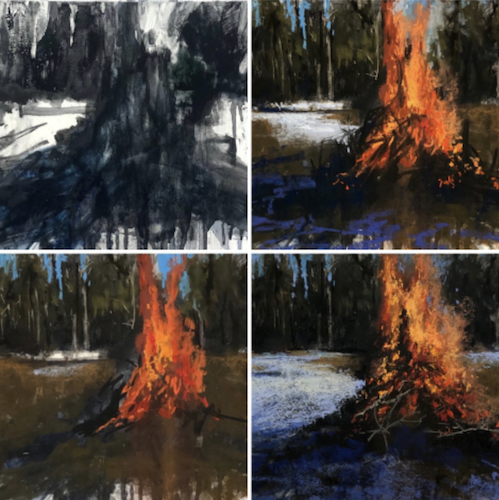
Step Three: I move on to the smoke
Adding a thin, transparent layer of smoke and carefully softening the edges between the smoke and the background, I make sure I leave it transparent so the background shows through the smoke. I then make sure most of the edges of the painting are soft so the hardest edges stay at the focal point of the fire. I use a toothbrush splatter technique in the foreground to capture the glitter of light from the cast glow of the fire in the foreground.
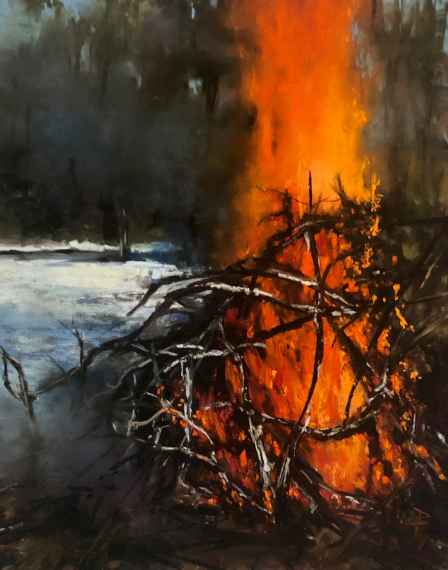
Art enables us to find ourselves and lose ourselves at the same time. ~ Thomas Merton.
*****
Okay, are you as warmed up as I am both with awe and the heat coming off those flames?!
Beth and I would love to hear your responses to her paintings and her art journey. Certainly, the hard hitting realisation that she lost her teenaged son, will affect many of you as it has me. And once again, art (and nature) come to the rescue, helping to heal such grief.
That’s it for this time.
~ Gail










![Pastels on black aper: Gail Sibley, "Untitled [at this point], Mount Vision pastels on Sansfix pastel card, 5 1/2 x 7 3/4 in](https://www.howtopastel.com/wp-content/uploads/2016/04/IMG_9649-2-150x150.jpeg)




12 thoughts on “Beth Tockey Williams and The Allure of Fire”
Oh Wow Gail. So grateful for this introduction to Beth’s mesmerising paintings. They had me entranced – with both the subject matter and the skill involved in capturing it so masterfully. It’s certainly increased my motivation to try harder and reach further.
Ohhhh Lea – that is soooo AWESOME to hear! I especially love that you received a motivation nudge!
Hi, Beth states that she seals in the background with clear Gesso. How is that possible as Gesso is normally brush applied. Wouldn’t this just mess up all the pastel?
Ohhhh great question Roy! I’ll leave Beth to respond.
Hi Roy. The first layer of my pastel paintings are an alcohol wash, then sealed with clear gesso. Details of the background are completed in a light layer of pastel, then sprayed with Sennelier Latour fixative before I work on the next layers of fire and or smoke. I hope that helps clear ip any confusion.
How lovely to be able to build fires and then to recreate them with such beauty! I have been to Edisto a couple of times (I’m in the upstate of SC) and I understand how there would be plenty of debris to burn. Also, I really appreciated Beth’s description of her process. Clear and concise! Thanks Gail for another great blog post.
Yay Ruth! Happy to hear Beth’s post – her words, process, and art – struck a chord with you.
And yes, building fires and then painting them with such brilliance!
I love Beth’s fire paintings–so emotionally mesmerizing. I love the contrasts of light and dark, warm and cool. She’s inspired me to try a fire painting.
Vicky
That’s it! “Emotionally mesmerizing!” That’s exactly what they are.
So happy Beth’s post has inspired you to try one of your own fire paintings Vicky!
These are wonderful! I have several bonfires yearly on my wooded acreage. Beth captures the light and atmosphere within and around the fires so accurately. Her process description is excellent, too. What brand of pastel does she prefer for those wonderful fire colors?
So happy to hear that Stephen! Hope to see some fire paintings from you 😀
And I’ll leave Beth to answer your question!
Stephen,
I use most of the brands but I seem to use Nupastel, Girault and Terry Ludwigs on repeat lately.